Monday, January 16, 2012

Restoring and Rebuilding your Inner Core Part III - Finding the Deep Muscles of the Spine

Deep muscles of the back.
(Multifidus shaded in red.)
Image from Wikipedia
In the previous two lessons on Restoring and Rebuilding the Inner Core, I have focused on Mula Bandha and Uddiyana Bandha. I also talked a little bit in the first lesson about the respiratory diaphragm. These are three of the main "Core 4" of the Inner Core. The fourth main component of the inner core is the Multifidus - the deep muscles of the spine which work to stabilize the joints at each segmental level. So how do we work this part of our inner core?

Exercise 3: Finding the Deep Muscles of the Spine through Arch and Flatten

Setting up:
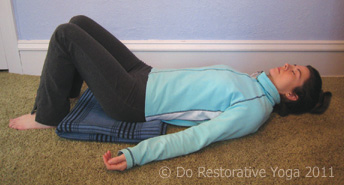
Start by laying on your back on the floor with your knees bent (Constructive Pose) and find a smooth, deep, and steady breath. Notice the rise and fall of the belly. Notice any other areas in your body that move with the breath.

Working in the pose:
After establishing your breath, begin to exaggerate the movement of the belly and the spine. On your inhale, relax everything and let the belly rise. On your exhale, draw the pelvic floor muscles up toward the area behind your belly button and pull your lower belly backward toward the spine. Let your spine press into the floor as your tail curls up slightly. On the inhale soften the pelvic floor and the lower belly muscles and begin to engage the muscles of the lower back by purposely pressing the sacrum into the floor and exaggerating the curve of the lumbar.

Take 5-10 rounds of this purposeful arching and flattening (tiny bit of a tail curl), practicing a muscular hand-off from the front line of the body to the back line of the body. Notice if other parts of the body want to get into the act. Do you find your arms wanting to roll in on the exhale? Do your knees want to press together on the exhale and open like a flower on the inhale? Do your arms also want to flower open on the inhale? If any of these movements are happening, go with it.

Finishing:
When you feel you have made a good connection with the deep muscles of your spine let yourself soften and return to your smooth, deep, and steady breath. Take any finishing movements that you like: a long stretch, a bundle roll hug, gentle twist, etc.

Homework:
1) Pelvic floor lifts: 10 each, 5 times a day from any position: sitting, standing or laying down.
2) Heel lifts or toe taps: 5-10 on each side making sure to keep the pelvis stable and neutral and maintain an easy breath.
3) Spine awareness through exaggerated arch and curl.

Previously:
Lesson I: Restoring and Rebuilding your Inner Core Part I - Finding Mula Bandha
Lesson II: Restoring and Rebuilding your Inner Core Part II - Strengthening Uddiyana Bandha.

Up next: More exercises to improve your core.

Monday, January 9, 2012

Book Review: The 7 Day Energy Surge

I'm reviewing this book because I am heading into a retreat training for maurices and this is a book that they ask their retreat participants to read. I like to be at least sort of up on the retreat topic (ha ha). So when I was given a copy of the book I decided I would look it over. I imagined I would just leaf through and pick out the good bits. Well, apparently I am not a "leaf-er."

I opened the book up at the beginning and read the entire thing. It was pretty easy reading with lots of good tips for living a healthy lifestyle. Once in a while I felt like I was in an infomercial because of the ALL CAPS TO MAKE A POINT style of writing but I am mostly past that. (As an editor, I do find all caps somewhat jarring.)

I found myself agreeing with the author on a number of points (yoga is good, repetitive exercise is bad for the joints, sugar is bad, fruits and veggies are good, sleep is good). I also found myself questioning his direction on a number of points particularly surrounding the issue of eating meat (how much "protein" to eat in a day, where does a vegetarian get their protein - he mostly advises eating meat and/or eggs, what are the ethical implications of eating so much meat - meat, fish and seafood every day for most meals).

That said, I am particularly healthy and should be surging with energy according to the quiz at the beginning of the book. Sometimes my answers weren't even options. I.e. The "best" answer for the question on Drinking Habits goes like this, "My drinking habits are [5 - really good] because I only have one cup of coffee first thing in the morning and drink more tea (he means caffeinated tea) and at least 75-80 oz. of water a day. I've also cut my alcohol consumption to 4 glasses of wine a week."

Really? I don't even drink coffee every day and I never drink tea with caffeine and I sure don't drink up to 4 glasses of wine a week. I realize his quiz questions are just to get an idea of your lifestyle and how that might affect your energy, but I was pretty surprised when on a number of questions his "best" option was not in line with what I would consider healthy. Makes me wonder if I am a total oddball.

Still, I always enjoy reading about health and I would recommend this easy-reading book.

Monday, January 2, 2012

Restoring and Rebuilding your Inner Core Part II - Strengthening Uddiyana Bandha

If you have read the previous post, Restoring and Rebuilding your Inner Core Part I - Finding Mula Bandha, and practiced the exercises, you should have an understanding of how the pelvic floor (the muscles between the tailbone and pubic bone and from sit bone to sit bone) and the transverse abdominus (the innermost of the flat muscles of the abdomen) engage and support you. In this post, we will continue our inner core work with a basic technique for strengthening the transverse abdominus.

Exercise 2: Strengthening the Transverse Abdominus

Setting up:
Start by laying on your back on the floor with your knees bent (See previous post for a picture). Find a neutral pelvis - hip points and top of pubic bone are on the same plane. Do a couple of pelvic tilts and tucks to find neutral. When your pelvis is in a neutral alignment you should have a slight curve in your lumbar spine, just as you would when standing.

Find a regular, steady breath and practice a few rounds of inner core engagement in conjunction with the breath (Exercise 1).

Working in the pose:
After establishing your breath and your inner core engagement, begin to add load by slowly lifting one heel off the ground, re-settling it, and then lifting the other. This is called heel lifts. Sounds easy, I know. But what is not always easy is maintaining your breath, your inner core engagement, soft jaw, soft shoulders, and a perfectly neutral pelvis while doing this.

Keep your hip points equidistant from your lower ribs, keep your lumbar slightly curved - not over tilted and not smooshed to the floor. Let your palms rest on your hip points and your finger tips point down toward your pubic bone. This will help you feel any movement in the pelvis as you try these heel lifts.

If you are perfectly steady doing heel lifts, you can add on by lifting your whole foot off the floor. First peel up the heel then let the toes lift off. Settle your first foot completely before you try your second foot. Now you are doing toe taps. Look for the same "tells" that you are overdoing it: you have forgotten your breath, you have let your pelvis stray from neutral, you have clenched your jaw or rounded your shoulders. If any of these things are happening, go back to heel lifts.

What I notice in my body when I do this exercise is that I am very stable on the left side but very wobbly on the right side. This is fairly common for folks who have SI joint dysfunction, back pain, or who have had an injury or surgery. If this is true for you, work to the level of the "weaker" side and don't over do it. This is slow, mindful work. It takes time and careful effort to build stability. And for some of us it will likely be a life-long pursuit.

Finishing:
Let yourself completely relax after your heel lifts and/or toe taps. Soften Mula Bandha and Uddiyana Bandha. Take any finishing movements that you like: a long stretch, a bundle roll hug, gentle twist, etc.

Homework: 1) Pelvic floor lifts: 10 each, 5 times a day from any position: sitting, standing or laying down. 2) Heel lifts or toe taps: 5-10 on each side making sure to keep the pelvis stable and neutral and maintain an easy breath.

Previously: Restoring and Rebuilding your Inner Core Part I - Finding Mula Bandha. Visit this post to read the benefits of pelvic floor and pelvic girdle work and to learn or review Exercise 1.

Up next: More exercises to improve your core.

Monday, December 19, 2011

Restoring and Rebuilding your Inner Core Part I - Finding Mula Bandha

In my previous posts I spoke quite a bit about the inner core. But what does this mean exactly? It's not just your abs - yoga doesn't care if you have a 6-pack. The important thing is to have a calm, strong, and steady center. Inner core work is vital to this process. Below, I detail the first exercise to help you start to rebuild and strengthen your core.

Exercise 1: Finding Mula Bandha (pelvic floor engagement) and Uddiyana Bandha (lower abdomen engagement)


Setting up:
Start by laying on your back on the floor with your knees bent (Constructive Pose). Find a neutral pelvis - hip points and top of pubic bone are on the same plane. Do a couple of pelvic tilts and tucks to find neutral. Use extra padding (folded blankets) as needed under the bum or under the neck/head for comfort.

Find a regular, steady breath. Notice how the inhale causes the respiratory diaphragm to press down into the organs which in turn press down into the pelvic floor (this is subtle - don't worry if you can't feel it yet). The exhale returns the respiratory diaphragm to its resting "umbrella-like" position under the rib cage.

Working in the pose:
After establishing your breath, begin to exaggerate the movement of the belly and pelvic floor. On your inhale, relax everything and let the belly rise. On your exhale, pull your belly toward your spine without moving your actual spine - keep your pelvis neutral. Now you are engaging the transverse abdominus and Uddiyana Bandha. Inhale and soften again. Take a few rounds of this breath. Inhaling and relaxing, exhaling and engaging.

Adding on, we will start to find the pelvic floor muscles. On your exhale I want you to engage the pelvic floor muscles (these are the muscles between the tailbone and pubic bone and from sit bone to sit bone) and the belly muscles (transverse abdominus). Pull the pelvic floor muscles up toward the area behind your belly button and pull your lower belly back toward the spine. Don't worry if you can't figure this out at first. It takes practice. On the inhale, relax everything again. Take a few rounds of this type of breathing. Inhale and relax, exhale and engage belly and pelvic floor.

If you can imagine your muscular engagement as a dial, practice your engagement at different levels of engagement. Try about a 3, then dial it up to a 7; try a 10 (completely engaged) then dial your engagement back to a 1 or a 2. Practice these different levels to become familiar with the amount of effort it takes to engage. Why? Because you don't need to dial up your engagement to a 10 if you are only picking up a water bottle. But what if you are picking up a toddler or a heavy rock? Then you need more muscular engagement.

Finishing:
Let yourself completely relax after working Mula Bandha and Uddiyana Bandha. Take any finishing movements that you like: a long stretch, a bundle roll hug, gentle twist, etc.

Benefits of Pelvic floor work:
Helps reverse or prevent incontinence; Can assist in reversing or preventing prolapse; Improves sexual functioning; Improves your fluid movement and connection with your inner core.

Benefits of Pelvic girdle work:
Creates stability in the pelvis; Reduces back pain; Reduces SI pain; Creates a center that is unshakeable; Improves posture and stability from the inside out.

Previously: My Story Part IV: Restoring my Inner Core
Up next: More exercises to improve your core.

ps - Just 5 minutes a day of these exercises can help you. You don't even have to lay down and take time out of your day (although you should give yourself a break). You can practice your inner core engagement while you are sitting at your desk, waiting for a stop light, doing dishes, or any time you think of it.

Monday, December 12, 2011

Winter Wonder Yin

I'm taking a little break from writing about the inner core to bring you a bit of info about keeping healthy and stress-free over the winter and the holidays. The following article from Yoga Journal explains the TCM (Traditional Chinese Medicine) perspective on winter, the holidays, and learning to keep rhythm with our body's natural cycle.

An acupuncturist explains why the final month of the year, an inherently yin season, is not the time to indulge in yang activities like shopping, partying, and staying up late. By Laurel Kallenbach

The final few months of the year often find us in a frantic state of shopping, decorating, traveling, and other high-energy activity. Yet instead of having fun, we often end up feeling ill, anxious, or depressed. The reason, according to Taoist philosophy and traditional Chinese medicine, is that the action-packed schedules we keep at this time of year fall out of sync with the earth's natural cycles.

"We naturally have less energy to burn during the winter," explains acupuncturist Carolyn Cohen, L.Ac., who teaches at Yo San University, a college of traditional Chinese medicine (TCM) in Santa Monica, California. "So when we engage in behaviors more appropriate for summer—staying up late and dashing around town—it's no wonder that the forced cheer of the holiday season can wear a bit thin."

Taoist philosophy conceptualizes universal balance in terms of yin and yang, complementary forces that govern the universe. Yin characteristics are cool, wet, slow, feminine, and quiet, whereas yang is the opposite: warm, dry, fast, masculine, extroverted. Winter, the yin season, is a time for storing and conserving energy in the way a bear retains fat by hibernating, or a farmer stores food for the cold months ahead.

In agrarian cultures, people spend the shortest, darkest days indoors by the fire, eating warm, slow-cooked, nourishing food and sharing stories with their families. The incongruity between winter's restful, introspective, yin nature and the frenetic way many Americans spend their holidays can contribute to seasonal affective disorder, depression, exhaustion, and other manifestations of what is known in TCM as shen (or spiritual) disharmony.

"Winter solstice, just three or four days before Christmas, is the darkest, most yin day of the year," says Cohen. "Instead of turning inward, we're celebrating with excess and yang activity. This artificiality creates stress, and many people dread the season as a result."

To stay balanced during winter, suggests Cohen, conserve your yang energy. Restorative yoga, tai chi, qigong, and walking are best suited for yin season, as they safeguard your energy reserves. "Think of these practices as an investment of your 'energy paycheck,'" says Cohen. "Don't use up what little winter energy you have with overactivity and added stress."

Eating cooked, spicy yang foods provides another good way to replenish energy. Prepare yang-strengthening soups, slow-simmered stews, beans, roasted root vegetables, and warm drinks. Add yang spices such as garlic, ginger, black pepper, cloves, and basil to increase the warming effect. Minimize your intake of yin foods such as raw vegetables, salad greens, and cold drinks.

If you find quiet, more modest ways to celebrate the holidays, you'll stay in tune with the season and feel less need to release tension by overeating or rampant spending. You'll also have more time and energy to connect with close friends and family. If you're out of sync with the mall mobs with maxed-out credit cards, chances are you'll find yourself in step with the quiet, nurturing yin nature of winter.

Monday, December 5, 2011

My Story Part IV: Restoring my Inner Core

Restoring my inner core has been my mission ever since teacher training. My exploration of the inner core and learning to deepen my awareness began in TT. I continued this learning-path with extended studies specializing in the inner core with my teachers, Ann Maxwell and Susi Hately Aldous, and I dedicated two 40-day practices to the inner core.

I had two signs that there was some change happening in my pelvis, sacroiliac joints and inner core: 1) my left SI joint moved for the first time ever. Now this didn't feel good, but I still took it as a good sign because at least both of my SI joints were moving instead of one stuck and one hyper-mobile. And 2) my outside-to-inside kick in Tang Soo Do (a Korean martial art) became so much stronger that I was able to kick the training pad out of my teacher's hands. Sounds like a funny way to measure change but I knew my body and I knew that I was making a difference by practicing deep inner core work.

Image from Wikipedia
This work is quiet, mindful and can make me want to scream. I had to learn how to find, use and move my pelvic floor, transverse abdominus, multifidi, adductors, and abductors, and I had to breathe while I did all this concentrating.

All this work has not eliminated my SI joint instability but it has become manageable. When I keep up on my work (as little as 5-15 minutes a day of inner core work) I can manage my pain. When I get lazy and don't do my work, instability comes sneaking back into my body. But now, after 3-4 years of work I can bring back stability in a short time. And at least I know I have the option of helping myself get out of pain.

Previously: My Story Part III: Teacher Training and More
Next up: I will detail some of the exercises I did that helped me strengthen my inner core and regain some control over my life by reducing my pain.

Monday, November 28, 2011

My Story Part III: Teacher Training and More

I signed up for teacher training in 2007 through Yoga North, the studio where I was starting to learn about the inner core, good alignment, and not pushing too far. I wanted to learn to use yoga to help my pain and to strengthen my body the way I needed. The 200 hour teacher training met one weekend per month for 6 months. The weekends were quite rigorous. The hours were something like this: 1pm-9pm on Friday, 7am-9pm on Saturday and 7am-6pm on Sunday. In addition to the weekend trainings, we had homework: studying philosophy, writing papers, doing a 40-day practice and journaling our experience, completing take-home tests, and teaching practice classes to a willing participant or two (read: family, friends or co-workers) so we could hone our new skills.

When I went through teacher training, Yoga North was in process of becoming more therapeutically focused, expanding on the Inner Core and Anatomy and Movement Principles from Susi Hately Aldous: move in a pure range of motion; move with the spine in mind; move from the larger joints first; when you are on your mat don't move into pain and if you are already in pain don't move into more pain; less is more. These were exactly the things I needed to learn in my body and in my practice.

Some of the inner core exercises we did seemed so simple I didn't believe they could help. We did things like laying on the floor with bent knees and squeezing a block between the thighs, tightening a belt/strap around the thighs and pressing out into it, and practicing pelvic floor lifts. We did awareness practices too like closing our eyes and barely moving into a pose using all of our awareness to focus inside. This is how I found out that Triangle was hurting me. I felt the tiniest of twinges at my right SI joint and realized, "Oh my gosh, that twinge was in the exact spot where I get the stabbing pain when I walk! I think Triangle is hurting me!"

This is about as far as I can safely go
in Triangle. Yeah, it's tiny but
I'm not in pain later.
This was revolutionary. Now that I knew what was hurting me I could avoid it. I was regaining control over my pain. OK sure, doing Triangle in such a tiny fashion that I barely moved was a bit of an ego-buster but I would do about anything to avoid the a-knife-is-stabbing-me-in-the-butt-pain I had been experiencing for at least 5 years during every walk I went on.

Of course the down side to this awareness is that now that I knew what tiny twinge to look for (future pain indicator) I found it in places I didn't want it to be: pigeon, extended side-angle, revolved head to knee pose, revolved seated wide angle, any and every forward fold, any and every back bend. Yeah, that's right, everything hurt.

So basically I had to go backward to go forward in my practice. I had to relearn the basics: core strength (block and belt work, pelvic floor work, transverse abdominus work), alignment principles (move in a pure range of motion; move with the spine in mind; move from the largest joints first), and less is more (when you are on your mat don't move into pain and if you are already in pain don't move into more pain).

Working with these tiny movements and this deep awareness made me feel like I was in "pre-yoga" class. For a long time I felt like I wasn't doing enough, I couldn't feel enough in my postures, I wasn't getting a good enough stretch. But these devious ideas lead us to do more than we should, push too hard, deplete ourselves with no cause, and quite possibly, cause ourselves pain.

Previously: My Story Part II: Yoga's Dirty Little Secret
Next up: Restoring my inner core and building stability.