Showing posts with label Reviews. Show all posts

Monday, June 20, 2016

Letting go of what no longer serves

For the past three years I have been both contemplating this idea and living this practice: letting go of what no longer serves. Ever since we  moved from our duplex (occupied both units) to our condo (1/2 the livable space, limited garage storage, and no basement) I have been in the practice of letting things go.

The hardest of course was realizing that our beloved dog was in too much pain and just too sick to make the move with us. Having to let go of her was the most emotionally traumatizing. Of course it's a no-brainer that having her put to sleep was horrible and hard. But it's surprising that what shouldn't be hard to let go often can be.
  • The pull-out couch: No, it doesn't fit in our new space but what will we do if we have company?
  • Tools: No, I don't need a table saw, extension ladder, snow blower, etc. anymore. But what if I need them in the future?
  • My yoga room: I don't have my private space any more. Where will I practice? And where will I put all my props?
  • The yard and garden: What will I do if I can't garden? What will I do if I can't spend lots of time outside?

Thinking about all these things that I have let go, I am reminded of Deborah Adele's book, The Yamas and Niyamas: Exploring Yoga's Ethical Practice. In particular, the message on Aparigraha (non-possessiveness): what you posses, possesses you. I do not want to end up as a little old lady who keeps all the things that ever meant something, piled up and tucked away, creating clutter and the feeling of grasping the past, or maybe being buried by the past as things pile up around me. I want to keep fresh in my life, my ideas, my practice.

I recently read Marie Kondo's books, The Life-Changing Magic of Tidying Up: The Japanese Art of Decluttering and Organizing and her follow up book, Spark Joy: An Illustrated Master Class on the Art of Organizing and Tidying Up. I was amazed at her methodology. The practice of tidying up and decluttering for her means the practice of letting go of what no longer serves. She does this by holding each item to see if it still sparks joy. If it does, keep it; if it doesn't, let it go with thanks and gratitude.

Although I have already let go of so many things these past three years, after reading her books I was inspired to renew my efforts. There were some things I always skipped over when reducing: old ballet outfits, old swing dancing clothes, my stash of fabric, family mementos and hand-me-downs that had no use to me but which had a guilty hold over me, etc.

When I took the time to honestly look at these things, to hold them, remember the memories, realize this was no longer relevant to me any more, and give thanks to these items for the part they played in my life at the time I used them, I found a joy in remembering and in letting go. I was able to set aside the things that no longer served and I was able to reappreciate the things that still did spark joy.

Even though I have made an effort to have a gratitude practice in my yoga practice, it had not carried over into my decluttering practice. Reduce-and-reuse efforts in the past held more of a "Oh gosh, I really don't want to let this go" feeling, versus a "Thank you for being part of my life and providing joy and meaning" feeling. This change of attitude in decluttering really felt good. It feels so good to lighten my load and to do it with gratitude for the things that served me in the past.

In Marie Kondo's second book she says, "Tiding is the act of confronting yourself; cleaning is the act of confronting nature." Ms. Kondo only refers to yoga and meditation in passing but I am strongly reminded of Aparigraha by this practice of tidying. Especially since she insists that you must hold each thing to learn to hone your skill at what sparks joy for you. What this means is that you are honing your skill in what is true and relevant for you now. This enable us to let go of what no longer serves. If that's not yoga, I don't know what is.

Interested in lightening your load? I invite you to ask yourself, "What am I holding onto that no longer serves?"

Here's a few of my favorite quotes from the Aparigraha chapter in Ms. Adele's book, The Yamas and Niyamas, to help you along:
Like the breath when it is held too long, the things that nourish us can become toxic.

Anything we cling to creates a maintenance problem for us.

Our expectations keep us captive and often disgruntled, and yet we choose our attachments rather than our freedoms.

Best wishes to you in your practice of developing your "letting go" muscle and lightening your load.
Namaste ~ Sara

Saturday, November 21, 2015

Book Review: Dancing in the Bamboo Forest

Dancing in the Bamboo Forest ~ a travel memoir by Djahariah Mitra

Dancing in the Bamboo Forest cover pic
I was excited to receive this book with a request to review it. I seek out memoirs and especially memoirs written by women about their travels and personal journeys. And certainly this book falls into exactly these categories, with the added bonus that the travel and journey are yoga specific.

We start out with the author in an emotionally dark place in her life. She decides to go to India to study, travel and find herself. I think many of us who study yoga have that same urge; the urge to go to the birthplace of yoga, to immerse ourselves in the culture and philosophy. Mitra does this with a teacher training followed by travel, yoga teaching, dance training, and building relationships with fellow travelers and native Indians alike.

She shares her inner thoughts, her attempts to find happiness, her everyday ups and downs with living in uncertainty. She doesn't know how long she will stay in India, she doesn't know if she will be able to get a job that will support her to stay in India, she doesn't know if her health will hold out.

She struggles with finding contentment in the uncertainty. This is what I recognized the most in my own life journey: the practice of finding contentment in my discontentment. Quite the kōan. I learned more about this in my teacher training too. There it was defined as “limbic space” by one of my professors. It's the idea that we need to become comfortable in our discomfort, comfortable with not knowing, comfortable in the waiting. In the book, Mitra has a very hard time with this and I think, so do we all. It was hard for me to read, hard to stick with her discomfort, but I thank her for being so candid and for sharing her struggle.

Interspersed with her personal journey, she shared some of her yoga understanding. I enjoyed her discussion of yoga philosophy, especially the part about being called to a spiritual life while still being a “regular” person, or as I've sometimes heard it called, a householder. Again, this is a struggle I understand. The essential question is, how do we give up everything and remain in this life? There's no right answer but I wonder if part of the struggle is in the phrasing “give up everything”? Perhaps if we thought we were gaining, not giving up, there wouldn't be a question.

And finally, as in other books I've read where an American woman goes to India, there is the culture shock to contend with. Women are 2nd class citizens, do not have rights the way men do, are not allowed to go out by themselves, travel by themselves, or wear less than 3 layers of clothing on all parts of their body. The author did find places where India is more modern, places where she could go out to coffee and even meet with male friends but it was not encouraged by society. She got questioned and shamed by her landlords for doing things like having male guests for dinner. It just seems so archaic and unfair to me. It's so hard to reconcile this part of Indian culture with the mindful practices of yoga that also came out of this culture.

The dichotomy of Indian culture, the blow-by-blow account of daily ups and downs, and the topic driven writing style (vs. linear) sometimes made this book difficult for me to read. When I could let go of my desire to know exactly where and when the author was, and when I could let go of wanting India to be as holy as I imagine it, the book was much more enjoyable to me. This book is worth reading if you want to know more about yoga, Indian culture, and if you want your own beliefs challenged as you read about someone else's personal growth.


Monday, July 15, 2013

Book Review: May I Be Happy

I had a hard time connecting with this book at first - there was so much negative self talk. I was noticing that my buttons were really being pushed by the phrase, "I'm so fat." I remember saying that all the time in high school and I worked really hard in college and afterward to let go of that saying and that habit of negative thinking.

I came to realize as I read on that Cindy Lee was experiencing the same thing but for her, the negativity went on for years and years. Maybe that is why it was so hard to read at first. I just wanted her to have gotten over it already. But the more I read, the more authentic the book felt to me and the more I empathized with Lee as a person.

I enjoyed reading excerpts of Ms. Lee's classes. I like her style and the way she passes on the knowledge of Buddhism and Yoga. I think I would enjoy being a student in her class. It was interesting to read how compassionate she is with her students but how unforgiving she was with herself.

The point of the book is her journey toward compassion and self love. And it seems that she has been able to arrive in a much more positive place. I am happy for her that she was able to realize that it was her mind that needed changing, not her body.

Read more on amazon.com.

Monday, November 5, 2012

Dreamland: Adventures in the Strange Science of Sleep


Ah, sleep: one of my favorite topics (as expressed here in a quote from The Princess Bride):

Get some rest. If you haven't got your health, then you haven't got anything.~ Count Rugan

So true.

For folks who fall asleep as soon as your head hits the pillow and for folks who stay asleep through the night, you might think it's silly to worry about getting enough rest. But for those of us who are or have ever been afflicted with insomnia you will appreciate this book.

The author, David K. Randall, takes us from mundane to murderous, exploring various sleep scenarios and the beliefs, ethics and treatments surrounding our multiple issues with sleep (or lack there of).

Although sleep walking (and sleep eating, sleep driving, etc.) are interesting to me, it's the everyday topic of lack of sleep which is close to my heart. Randall does a great job of covering sleep deprivation whether by parenting, disease/genetics (think snoring and sleep apnea and the partners of those people), or employment (think military, doctors, pilots, truckers, etc.) - and the resulting lack of coherency. This is truly frightening. The military is starting to realize that many cases of "friendly fire" are strongly correlated to their troops lacking sleep. Also, sleep deprivation studies show an increasing inability to make good decisions the more sleep deprived we are.

I think one of the scariest things I read in this book is about a genetic anomaly which thankfully does not affect very many people. The anomaly is this: at about age 40 there are certain people who slowly lose the ability to sleep - at all. They do not feel tired and they do not lose coherency. According to Randall, every one of these people die within a year. This is what lack of sleep does to us.

It makes me wonder, for every hour of sleep we missed, are we shortening our life span?

One topic not covered in as much depth as I would have liked is the effect of yoga, meditation, and in particular, Yoga Nidra (not mentioned at all). Regardless, this book is worth a read. I highly recommend it.

Book's website: Norton Books
Author's website: David K. Randall
Reviews: NPR Review, Salon Review, NY Times Review

Monday, October 1, 2012

Book Review: Om Love

This was a hard book to like and also a hard book to put down. The characters were too real for me to feel comfortable and yet I wanted to know what happened to them. The writing style was choppy, raw, and stream of consciousness. At first I couldn't stand it. As an editor I wanted periods and capitals. And then my mind went with the flow and I didn't mind. I was compelled to finish. I can't say that I recommend it, but I wouldn't say don't read it either. Oh, it's a maddening book to describe or categorize. You'll have to see for yourself.

Thursday, August 23, 2012

Book Review: The Immortal Life of Henrietta Lacks

This book is a mystery, a science tale, a personal story, and an excellent review of medical ethics. The book description on Amazon reads:

Her name was Henrietta Lacks, but scientists know her as HeLa. She was a poor Southern tobacco farmer who worked the same land as her slave ancestors, yet her cells—taken without her knowledge—became one of the most important tools in medicine. The first “immortal” human cells grown in culture, they are still alive today, though she has been dead for more than sixty years. If you could pile all HeLa cells ever grown onto a scale, they’d weigh more than 50 million metric tons—as much as a hundred Empire State Buildings. HeLa cells were vital for developing the polio vaccine; uncovered secrets of cancer, viruses, and the atom bomb’s effects; helped lead to important advances like in vitro fertilization, cloning, and gene mapping; and have been bought and sold by the billions. 

This book is a true tale which reads like a novel: you don't want to put it down, but there is so much to think about ethically that you have to take your time. I did anyway. I would read a bit, let the book rest, go back to it and read a bit more.

The author, Rebecca Skloot, tells us the facts about HeLa cells and about the (billion dollar) medical industry which grew from these immortal cells. She gives an insider's view of the family of Henrietta Lacks, especially Henrietta's daughter. In particular, how she was kept in the dark about all the science happening to her mother's cells (and all the money being made).

Ms. Skloot explores the ethics of growing human cells for profit and explains how most of do not have any rights over our own cells once they leave our body (ever get a wart removed? it's probably in a medical freezer somewhere just waiting to be experimented on), all without seeming to pass judgement on any one person or any institution. This is great writing. We all get to make up our minds about how we feel.


Monday, July 30, 2012

The Forest Unseen ~ A Year's Watch in Nature: Part II

In my previous post I shared an insight from the author of The Forest Unseen ~ A Year's Watch in Nature which I felt was relevant to the 30 Day Meditation Challenge. But I liked the book so much that I want to share a few more passages.

On the topic of declining wild forest health and the rise of the industrial (monoculture) forest David Haskell says,

The scale, the novelty, and the intensity of this change are unquestionable threats to the diversity of life in the forests. Whether or how we respond to this erosion is a moral question. Nature seemingly provides no moral guidance; mass extinction is another of her many flavors. Neither can moral questions be answered by our culture's obsession with policy think tanks, scientific reports, or legal contests. I believe that the answers, or their beginnings, are found in our quiet windows on the whole. Only by examining the fabric that holds and sustains us can we see our place and, therefore, our responsibilities. A direct experience of the forest gives us the humility to put our life and desires into that bigger context that inspires all the great moral traditions.

I was struck by this quote because I am so strongly in support of preserving our forests that to question the morality of it was surprising to me. Thankfully, the author, who is much better with words than I am, goes on to answer this riddle for me.

Can the flowers and bees answer my questions? Not directly, but two intuitions come to mind by contemplation of a multifarious forest whose existence transcends my own. First, to unravel life's cloth is to scorn a gift. Worse, it is to destroy a gift that even hardheaded science tells us is immeasurably valuable. We discard the gift in favor of a self-created world that we know is incoherent and cannot be sustained. Second, the attempt to turn a forest into an industrial process is improvident, profoundly so.

The problem with our modern forest economy lies in the unbalanced way that we extract wood from land. Our laws and economic rules place short term extractive gain over all other values. It does not have to be this way. We can find our way back to thoughtful management for the long-term well-being of both humans and forests. But finding this way will require some quiet and humility. Oases of contemplation can call us out of disorder, restoring a semblance of clarity to our moral vision. ~ David Haskell

The thoughtful and precise language in this book fed my soul. I couldn't tear through this book as I would a novel. This book is one which deserves a slow, mindful read. Many thanks to the author and to the publisher. Great book!


Monday, July 23, 2012

Book Review: Yoga Cures

Yoga Cures, by Tara Stiles, offers up advice for a multitude of problems ranging from PMS to diabetes to jiggly thighs. The routines are simple and easy to follow by using the pictures and descriptions in the book.

She has a very conversational style of writing which I came to appreciate. She makes yoga accessible to all people.

At times though, I felt she was a bit too informal, even a bit flip. For example, in writing about diabetes Ms. Stiles says, "The yoga cure for diabetes is first to prevent getting this sickness by keeping a regular practice and healthy lifestyle."

This feels like a judgement to me. Not all people develop diabetes due to an unhealthy lifestyle.

Also, I would have liked to read the science behind each pose. I wanted to know why she chose what she chose for each problem. She does give an overview, sharing her reasoning, but I guess I would've liked something more in depth.

That said, this is still a worthwhile book. I came away from it knowing a few new poses to introduce to my students and I do appreciate the down-to-earth approach of Ms. Stiles.


Monday, July 2, 2012

The Forest Unseen ~ 30 Day Meditation Wrap-up

Throughout the 30 Day Meditation Challenge I was reading a wonderful book, The Forest Unseen ~ A Year's Watch in Nature. This book is a cross between meditation and biology. It was not a book to hog down like The Hunger Games. Rather, it was to be taken in small sips, savored and let to bubble inside.

The author, David Haskell uses the idea of a Tibetan mandala, in this case a patch of old-growth Tennessee forest, as a window into the natural world. He committed to visiting this mandala, as often as he could, for one whole year. As I read, I was continually delighted with both the learning I was gaining through his knowledge of the natural world, and with his obvious connection to meditation / yogic philosophy. And, I am amazed at his perseverance; committing to sit every day for 30 days seemed like something - but committing to sit for a year? Wow.

I would like to pass on one of the author's insights, a summing up of his year, based on his idea of taking a meditative stance while sitting in nature:

The interior quality of our minds is itself a great teacher of natural history. It is here that we learn that "nature" is not a separate place. We too are animals, primates with a rich ecological and evolutionary context. By paying attention, this inner animal can be watched at any time: our keen interest in fruits, meats, sugar and salt; our obsession with social hierarchies, clans and networks; our fascination with the aesthetics of human skin, hair, and bodily shapes; our incessant intellectual curiosity and ambition. Each one of us inhabits a storied mandala with as much complexity and depth as an old-growth forest. Even better, watching ourselves and watching the world are not in opposition; by observing the forest, I have come to see myself more clearly.
~ David Haskell

Lovely perspective. Is that not what we are each trying to do as we sit? We are looking to know ourselves better; to know our light and our shadow; to know ourselves as one with all.

Monday, January 9, 2012

Book Review: The 7 Day Energy Surge

I'm reviewing this book because I am heading into a retreat training for maurices and this is a book that they ask their retreat participants to read. I like to be at least sort of up on the retreat topic (ha ha). So when I was given a copy of the book I decided I would look it over. I imagined I would just leaf through and pick out the good bits. Well, apparently I am not a "leaf-er."

I opened the book up at the beginning and read the entire thing. It was pretty easy reading with lots of good tips for living a healthy lifestyle. Once in a while I felt like I was in an infomercial because of the ALL CAPS TO MAKE A POINT style of writing but I am mostly past that. (As an editor, I do find all caps somewhat jarring.)

I found myself agreeing with the author on a number of points (yoga is good, repetitive exercise is bad for the joints, sugar is bad, fruits and veggies are good, sleep is good). I also found myself questioning his direction on a number of points particularly surrounding the issue of eating meat (how much "protein" to eat in a day, where does a vegetarian get their protein - he mostly advises eating meat and/or eggs, what are the ethical implications of eating so much meat - meat, fish and seafood every day for most meals).

That said, I am particularly healthy and should be surging with energy according to the quiz at the beginning of the book. Sometimes my answers weren't even options. I.e. The "best" answer for the question on Drinking Habits goes like this, "My drinking habits are [5 - really good] because I only have one cup of coffee first thing in the morning and drink more tea (he means caffeinated tea) and at least 75-80 oz. of water a day. I've also cut my alcohol consumption to 4 glasses of wine a week."

Really? I don't even drink coffee every day and I never drink tea with caffeine and I sure don't drink up to 4 glasses of wine a week. I realize his quiz questions are just to get an idea of your lifestyle and how that might affect your energy, but I was pretty surprised when on a number of questions his "best" option was not in line with what I would consider healthy. Makes me wonder if I am a total oddball.

Still, I always enjoy reading about health and I would recommend this easy-reading book.

Monday, September 26, 2011

DVD Review ~ Yoga for Total Back Care

 Yoga for Total Back Care features vinyasa flow teacher Annie Carpenter.

This DVD features two 45-minute sequences which target the back's major problem areas: one for the lower back and one for the upper back, neck, and shoulders.

The first sequence I tried was for the lower back. I had been working on a few different house projects through out the day: painting in the morning and then hauling, mixing, and pouring concrete for a couple hours in the afternoon. My low back was really feeling sore and stiff and I knew I needed to do some yoga. So, I decided to try out this DVD.

Carpenter started us on our backs with pelvic tucks and tilts, eased us into Supta Padangustasana and then led us into some core work. She brought us to upright and we did a few long held lunges with down dog transitions and then moved into standing poses like Warrior I, Revolved Side Angle and Wide Leg Forward Fold with a twist. She emphasized keeping a level pelvis and keeping our breath steady and smooth. We finished on the floor again with some block-assisted Bridge Poses, gentle twists and a hip stretch.

After Savasana I felt great. My low back was not hurting me at all. After carrying all that concrete I was worried but this sequence helped me get out of pain.

I tried the Upper Back, Neck, and Shoulders sequence the next day after painting for about 6 hours. My right arm, shoulder and neck were very tight and I was getting a headache on the right side too. I try to paint with both hands to bring balance but I can only manage to use my left hand about 20-25% of the time.

This sequence focused on noticing the differences that you might have between the right and the left side, building strength and releasing tension. We started out on our backs again and rolled our heads slowly from side to side which felt great. Then we worked on some shoulder stability with blocks, transitioned into table for cat-cow, down-dog and hanging fold. From there, we moved into slow flowing postures: sun breath + chair, WII + Extended Side Angle, and Plank to Down Dog flow. We came down to our bellies for a Belly Boat flow and ended with some seated arm stretches - Cow's Face arms and Eagle Arms. After a gentle twist we settled into Savasana.

I didn't connect with this sequence as much as the first one. But perhaps that is because it was more challenging and I felt like relaxing, not working. I know I need more strengthening though because I often have ribs out of alignment in my upper back which tells me I don't have enough stability.

I was a little worried that this would be too vigorous a practice for me to enjoy but I was pleasantly surprised to find a smooth, calm, and flowing practice that really did make my back feel better - especially the low back sequence. Over all, I liked the DVD and would recommend it.

Monday, September 19, 2011

Book Review: Sideways on a Scooter

I am signed up for the Duluth Public Library's Daily Book Review (click here to see the categories you can sign up for). I receive a book review every day by email and if I like the look of it I can go on line and request the book to be held for me. When the book is in, they send me an email and I have a week to pick it up. The DPL is the best!

Anyway, "Sideways on a Scooter ~ Life and Love in India" piqued my interest and I requested it (but not quick enough - at least 4 people were in line before me). This book is a memoir of/by Miranda Kennedy in the years she worked as a foreign correspondent out of India.

I guess I was expecting something more romantic and "happy ending" - more like "Eat, Pray, Love." But what I got was the gritty truth about the enigma that is India. Kennedy explores race and class/caste issues in depth and left me feeling quite uncomfortable with the juxtaposition of yoga and yoga's origins. Kennedy does not even explore yoga (well, there is a Women's Fitness Center where there is a yoga class but the women really just go to the center to socialize and get away from the prying eyes of men), but I am struck by the "all people are equal and we are all divine" message of Western yoga and the reality she saw of complete caste inequality; of Indians purposely keeping the castes in place and being happy about it; of women purposely keeping other women down. Ms. Kennedy does a great job of diving in to Indian culture and helping us understand it. She appears to be very uncomfortable in her situation but she sticks it out, learns, and shares her learning with us.

I am still reeling from the book which to me says that this is one we all should read - especially if we have a romanticized notion of the roots of yoga, which apparently I do since I am stunned by the book.

Monday, September 12, 2011

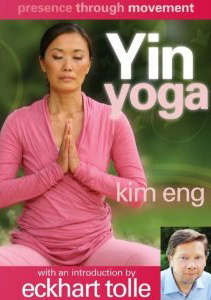
DVD Review ~ Yin Yoga

I am always on the look out for new Restorative, Yin and Deep Relaxation information. I recently purchased "Yin Yoga," a DVD by Kim Eng with an introduction by Eckhart Tolle.

The DVD features two practices plus a lecture/introduction with Eckhart Tolle. I came away from the introduction with the reminder to stay present in the practice, notice if you have discomfort or if your mind wanders. Bring the mind back to the present, time and time again. Do not run from discomfort; explore it.

Ms. Eng offers two practices: The Full Practice - Complete Yin Yoga (75 minutes) and the shorter Daily Practice (60 minutes) which is a copy of some of the poses from the full practice. Each practice is soothing and well presented. The style is voice-over set to Ms. Eng's practice in a beautiful garden. She did offer modifications and talked about using props but did not often show the props or use the props herself. I find in my classes that maybe one person per 15 does not need props - everyone else does. But I know that "no props" is more in the Yin style so I was not expecting to see any props or even talk about using props so I was pleasantly surprised.

There was no information pamphlet / table of contents in the DVD jacket which is a disappointment, but this seems to be the norm these days. However, this is definitely a DVD that I will watch / practice with again. I really enjoyed it. If you want more info, there are quite a few reviews on Amazon - some of which are very detailed and helpful.

Monday, August 8, 2011

Seeking the Truth in Yourself

Image from Wikipedia
I recently watched the movie Invictus, a portrayal of Nelson Mandela, acted by Morgan Freeman, set in the 1990's, the time period just after Mandela's release from 27 years of unjust incarceration. Mandela was elected  president by the first truly free election, the first multi-racial democracy, in 1994.

Mahatma Gandhi's non-violent resistance, satyagraha ("truth force"), influenced Mandela's approach to ruling in South Africa. This was portrayed wonderfully in the movie. Mandela's ability to see the truth in himself--his greatness, his flaws, his prejudice, his desire for revenge, his desire for peace--allowed him to rule from a place of equanimity. His ability to look beyond himself and ask, "What is the best course of action for all people of South Africa?" made him an incredible leader.

Since watching this movie I have been wondering what would happen if we could all be so fearless? What would happen if we could all look inside ourselves and see both the greatness and the smallness that makes us who we are? Could we recognize what hooks us if we could see ourselves with perfect truthfulness? Could we find love and forgiveness in our hearts for ourselves and others the way Mandela (and Gandhi) did?

Om Shanti, Shanti, Shanti. Peace, peace, peace.

Monday, June 20, 2011

DVD Review ~ Yoga for Morning, Noon & Night

Yoga for Morning, Noon & Night features Jason Crandell, a contributing editor for Yoga Journal who also teaches at YJ conferences and leads workshops and retreats around the world.

This DVD includes three yoga sequences of about 20 minutes each - perfect for sneaking a bit of yoga into your day, even on a busy day.

The first practice is a gentle wake up session featuring Half Sun Salutations (Sun Breath) plus a nice shoulder opener, side bends, and core strengtheners. I loved the pace Crandell led. I felt very taken care of.

The second practice picks up the pace a bit, using Sun Salutation A, standing poses and back bends. Even though the practice was more vigorous  than the first one, I never felt rushed. I was able to keep my breath deep, smooth and steady. In a faster paced class I think it is easy to forget your breath but Crandell did not let us do that. Maintaining relaxation and breath awareness during a flowing practice is something I really appreciate.

The third practice took us down to the floor for seated and supine poses. Mostly we worked on hip and hamstring openers plus twists and back bends - with a few down dogs thrown in there as decompression after back bends. I felt very relaxed after this practice.

Over all I enjoyed this DVD quite a bit. Crandell's voice was soothing, his pace (even in the faster paced session) was spacious, and I appreciate his emphasis on paying attention to your body and not pushing yourself beyond your edge.

I watched his interview after the three sequences were over and found out that he had had a serious back injury in the past. Perhaps this is why I felt so comfortable with his teaching: he knows what it is like to be in pain and does not want his students to ever go to that place.

Monday, May 23, 2011

DVD Review ~ Yoga for Your Pregnancy

Yoga for Your Pregnancy featuring Kristin Eykel and published by Yoga Journal & Lamaze is a well designed, well presented, and well thought out production. The lighting, color and photography is superb.

The DVD offers two main practices for prenatal (30 minute Rejuvenating and 15 min Relaxation) plus an additional 16 minute postnatal practice. Other bonus tracks include Pranayama (7 min), Guided Meditation (5 min), Yoga in the Birthing Room (5 min), Lamaze philosophy overview plus interview with Carol Penn-Erskine (5 min) and a meet the teacher section (5 min).

The two prenatal practices showed variations for propping including using a chair but did not always offer alternatives if a pose was impossible in the body. For example, one of the poses offered was Camel. Now, as a therapeutic yoga teacher, I can say that maybe 1 or 2 of my 100+ students can do this pose without pain in the knees or the sacrum. Most of the folks I teach do not have the flexibility required for propless, high-test poses like Camel.

If an option for setting up blocks by the feet were presented, or an option for sitting on the chair and clasping the hands behind the back or at the chair-back while back-bending over the chair were presented, I would feel more comfortable recommending the DVD. But as a therapeutic teacher,  I felt very uncomfortable with a few of the omissions.

On the other hand, I know that the focus was on yoga for pregnancy and not every option can be covered in one DVD. The teacher seemed very knowledgeable about pregnancy, had been through a pregnancy herself and the other demonstrators on the DVD were pregnant themselves. I enjoyed learning more about Lamaze and since the teacher has a Kundalini background, I enjoyed the Kundalini-Hatha hybrid she presented.

One other curiosity: not once was Mula Bandha or the pelvic floor mentioned - not even in the postnatal practice. After birthing, I know pelvic floor exercises are a must-do to regain the tone required to avoid incontinence and to keep all the organs in place. I don't know a lot about pregnancy yoga so maybe someone can help me out here. Shouldn't a prenatal yogi practice Mula Bandha (kegel exercises)? Or is that too much upward energy before giving birth?

Monday, May 2, 2011

Book Review - Radical Healing

When I was asked to review the book Radical Healing (2nd edition) by Rudolph M. Ballentine, M.D., I thought, "Sure, why not? That shouldn't be too hard and it sounds interesting too." Then I received the book and was a bit taken aback by the size and scope of this 600-plus page tome.

Topic covered include: Nature's Medicinals - Herbal Traditions, Homeopathic Remedies and Cell Salts, Flower Remedies; Self-Assessment - The Meaning of Diagnosis, Body Maps, Techniques for Self-Diagnosis, Multilevel Diagnosis and Constitution: What's Your MInd-Body Type (Ayurveda); Foundation Stones - Nutrition, Detox, Movement and Exercise; Energy and Consciousness -  Energy and Breath, Healing as Transformation, Reweaving; and Resources - Self-Help Index and Home Medicine Kit, Guide to Further Study of Holistic Medicine, Products and Services.

The idea behind Radical Healing according to Dr. Ballentine is to present a comprehensive vision of medical care - one that brings together the various holistic modalities (Chinese Medicine, Ayurveda, Naturopathy) and integrates their insights and skills.

I love the personal tone Dr. Ballentine sets in his intro. We get to learn a bit about his background and hear some patient stories as examples. The reading is easy and interesting. It draws you in. And, as soon as the chapters start, there is practical information: like how to create your own homeopathic remedy for ragweed allergies. Cool!

I found myself wanting to go more in depth with each chapter. My interest was really peaked with each subject. I think each topic could be expanded into a book in its own right.

Although I have not yet read the book cover-to-cover, I am very pleased to have this book in my library. I know it is something I will reference time and time again.

The book is available through the publisher, Amazon.com and other retailers for $19.95 or less.

Published by the Himalayan Institute, www.himalayaninstitute.org, March 2011 by Rudolph Ballentine, M.D.,  a pioneer of the holistic health movement. Drawing on more than 40 years of study, medical practice, and research, Dr. Ballentine presents a comprehensive, practical system of dynamic healing. Our ultimate objective is to expand our self-awareness on all levels, and guides us toward our ultimate objective—a restoration of wholeness. The result is transformation. The result is radical healing.

Monday, August 23, 2010

Sharanam by Sharon Gannon

Sharon Gannon's new album, Sharanam, is almost impossible to classify. When I first listened to it I thought, "Oh, it's world beat with a yoga slant. But kinda rock/pop too. Huh, that's interesting and kinda weird." Then I listened to it again and I noticed the opera quality. Then I listed to it a few more times and found myself singing along and later found myself humming the tune of "Gurugi." Now I had to listen again so I could understand how something that at first I wasn't sure of had settled itself into my mind so firmly. I listened again and again, liking the CD more and more. I played the CD in my classes and it was well received. I find myself singing, "My guru is the truth, my guru is wisdom, my guru is ecstasy, my guru is shantih" as I walk to work, or walk the dog, or whatever. The whole album is catchy, heartfelt, inspiring and Sharon's voice is beautiful. Great insert too - all the lyrics are included. I highly recommend this CD.

Here's the official description of the CD from Amazon:
On her first solo recording, Sharon Gannon, co-founder of the Jivamukti Yoga Method, offers a personal and loving rendition of seven timeless mantras. Essential tools for a yogi, mantras serve as medicine for the body, mind and spirit, freeing our thoughts and bringing us in closer connection to ourselves and the natural world around us. Sharanam translates from Sanskrit as "refuge." These chants -- graced with seductive rhythms, tasteful electronic treatments and Gannon's soulful, impassioned voice -- will surely lead you to the sanctuary of your heart.

And here's a link to Sharon Gannon's website: Jivamukti Yoga School. You can listen to Gurugi on the home page. I love this song. Check it out!