Showing posts with label Yin Yoga. Show all posts

Thursday, December 19, 2013

Winter Yin Time

I've been feeling a bit out of sorts (as I know many of us do in the winter and around the holidays). All I want to do is snuggle up in my blankets and read, read, read. Or maybe watch some movies. But for some reason, I feel like this "introversion thing" is somehow wrong so I schedule up my time by signing up for classes, teaching more, and having or going to parties. None of these things are wrong, but I am definitely forcing myself to get out of the house.

Thankfully, I came across this article in Yoga Journal which makes me feel a little better about my hibernation tendencies. Maybe it is ok to slow down after all. Enjoy.

Winter Wonder Yin

An acupuncturist explains why the final month of the year, an inherently yin season, is not the time to indulge in yang activities like shopping, partying, and staying up late. ~ By Laurel Kallenbach

The final few months of the year often find us in a frantic state of shopping, decorating, traveling, and other high-energy activity. Yet instead of having fun, we often end up feeling ill, anxious, or depressed. The reason, according to Taoist philosophy and traditional Chinese medicine, is that the action-packed schedules we keep at this time of year fall out of sync with the earth's natural cycles.

"We naturally have less energy to burn during the winter," explains acupuncturist Carolyn Cohen, L.Ac., who teaches at Yo San University, a college of traditional Chinese medicine (TCM) in Santa Monica, California. "So when we engage in behaviors more appropriate for summer—staying up late and dashing around town—it's no wonder that the forced cheer of the holiday season can wear a bit thin."

Taoist philosophy conceptualizes universal balance in terms of yin and yang, complementary forces that govern the universe. Yin characteristics are cool, wet, slow, feminine, and quiet, whereas yang is the opposite: warm, dry, fast, masculine, extroverted. Winter, the yin season, is a time for storing and conserving energy in the way a bear retains fat by hibernating, or a farmer stores food for the cold months ahead.

In agrarian cultures, people spend the shortest, darkest days indoors by the fire, eating warm, slow-cooked, nourishing food and sharing stories with their families. The incongruity between winter's restful, introspective, yin nature and the frenetic way many Americans spend their holidays can contribute to seasonal affective disorder, depression, exhaustion, and other manifestations of what is known in TCM as shen (or spiritual) disharmony.

"Winter solstice, just three or four days before Christmas, is the darkest, most yin day of the year," says Cohen. "Instead of turning inward, we're celebrating with excess and yang activity. This artificiality creates stress, and many people dread the season as a result."

To stay balanced during winter, suggests Cohen, conserve your yang energy. Restorative yoga, tai chi, qigong, and walking are best suited for yin season, as they safeguard your energy reserves. "Think of these practices as an investment of your 'energy paycheck,'" says Cohen. "Don't use up what little winter energy you have with overactivity and added stress."

Eating cooked, spicy yang foods provides another good way to replenish energy. Prepare yang-strengthening soups, slow-simmered stews, beans, roasted root vegetables, and warm drinks. Add yang spices such as garlic, ginger, black pepper, cloves, and basil to increase the warming effect. Minimize your intake of yin foods such as raw vegetables, salad greens, and cold drinks.

If you find quiet, more modest ways to celebrate the holidays, you'll stay in tune with the season and feel less need to release tension by overeating or rampant spending. You'll also have more time and energy to connect with close friends and family. If you're out of sync with the mall mobs with maxed-out credit cards, chances are you'll find yourself in step with the quiet, nurturing yin nature of winter.

Article found here: http://www.yogajournal.com/health/101.

And to help us on our inward journey, a link to free guided meditations with Tara Brach: www.tarabrach.com.


Monday, February 13, 2012

Yang-Yin Photo Re-cap

Yang-Yin is a 2 hour Master Class which I co-teach with Kristin Fogard. We teach this class about 2x a year at Yoga North in Duluth, MN.

Kristin started us out with a series of flowing, Vinyasa style, postures and movements.....


I took over for the 2nd hour with a Yin style floor routine of long-held, gentle stretches.


Ahhhh....Savasana. The best pose of all.


Until next time, your fearless leaders, Kristin and Sara.

Monday, September 12, 2011

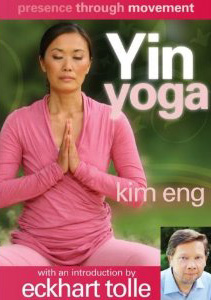
DVD Review ~ Yin Yoga

I am always on the look out for new Restorative, Yin and Deep Relaxation information. I recently purchased "Yin Yoga," a DVD by Kim Eng with an introduction by Eckhart Tolle.

The DVD features two practices plus a lecture/introduction with Eckhart Tolle. I came away from the introduction with the reminder to stay present in the practice, notice if you have discomfort or if your mind wanders. Bring the mind back to the present, time and time again. Do not run from discomfort; explore it.

Ms. Eng offers two practices: The Full Practice - Complete Yin Yoga (75 minutes) and the shorter Daily Practice (60 minutes) which is a copy of some of the poses from the full practice. Each practice is soothing and well presented. The style is voice-over set to Ms. Eng's practice in a beautiful garden. She did offer modifications and talked about using props but did not often show the props or use the props herself. I find in my classes that maybe one person per 15 does not need props - everyone else does. But I know that "no props" is more in the Yin style so I was not expecting to see any props or even talk about using props so I was pleasantly surprised.

There was no information pamphlet / table of contents in the DVD jacket which is a disappointment, but this seems to be the norm these days. However, this is definitely a DVD that I will watch / practice with again. I really enjoyed it. If you want more info, there are quite a few reviews on Amazon - some of which are very detailed and helpful.

Monday, July 18, 2011

Yin Style Reclining Hero's Pose ~ Supta Virasana

Enjoy Yin Style Hero's Pose

Restorative style Virasana, as explored in the previous post, is a great place to start lengthening your quads. But at some point your body may be open enough to try Yin style Virasana, known as Saddle Pose. One of the beautiful things about Yin is that there is not a huge need for props like there is with Restorative. But still, there is some prep work involved.

Setting up for the pose:
For this version of Virasana, I like to start by laying on my back. Some folks are limber enough to sit on their shins with their bottoms on the floor and then lay themselves down backward but for most folks that is a bit much to start with.

Coming into the pose:
So, laying on your back, roll a bit to one side, bend your top leg's knee and pull that foot toward your bum. Try to roll back to the floor. This is Half Saddle or Half Reclining Hero's Pose.


As you linger here, you may find yourself wanting to pull your other leg in and open like so:


If these both seem crazy but you want a bit more stretch than the Restorative style Hero's Pose is giving you, then I recommend trying Supported Bridge Pose with a quad stretch:

This is nearly the same effect, as far as stretching the quads, but it gives you more space to tuck the foot towards the same side hip since the bum is off the floor. You can turn the foot under (toes point toward the same side shoulder) or you can draw the ankle toward you and keep the toes pointing away. Do one side at a time and try to maintain good alignment: shoulder, hip, knee in the same line. This video by Kira Ryder details the process.

While in the pose:
Keep breathing, keep observing the pose in your body, and allow the body to open at its own rate. Commit to the stillness but do allow yourself to adjust your body as you settle deeper in. Breath into any places where you habitually grip and try to soften. Stay as long as you are comfortable.

Coming out of the pose:
If you are in Supported Bridge Pose, lift your bottom, slide the block out from under you and come to rest on the floor. If you are already on the floor, roll to one side slightly and untuck one foot and then the other. If you were practicing 1/2 Hero's take the 2nd side. After the second side you can be done or you could try the full version of the pose. Take a few sacrum circles and then Little Bridge Pose to bring back stability.

This posture was super hard for me at first. I thought I had knee trouble but it turned out it was just tight quads. After a few months of practicing this posture regularly - starting with the Restorative style supported Hero's and eventually working to the Yin style Hero's - my knee discomfort has gone away.

Thursday, April 28, 2011

Restorative and Yin at the YMCA

I subbed or "guest taught" at the YMCA last night and had a lovely time. It was great to see so many of my former students (and meet new students too). The Y is finally done with their renovations and the new Mind-Body room (yoga room) is very nice. Quiet, meditative, and nice paint colors.

I subbed for Thomas's Yin class but of course my style of Yin is more like Yin-Therapeutic-Restorative so I'm sure it seemed like a very different class for folks who are not used to my teaching style.

I started everyone off in Legs-up-the-Wall,

added in a #4 hip stretch 

and then flowed into Hand-to-big-toe at the wall.

From there we scooted ourselves off the wall 
so we could take in Supported Bridge Pose with a quad stretch.

Some folks did 1/2 Hero's Pose (reclining) instead of Supported Bridge with quad stretch (same effect - just using a block or not).

We rested in Child's Pose but added in Yoga Mudra (hands clasped behind the back, roll onto the crown of the head and let hands reach towards the floor over the head (sorry no image for that one yet).

Our final active pose was a true Yin lunge - 
low, deep and long-held.
This image is from Camp Amnicon Winter Reflection Retreat 2010.
 I let everyone do their own thing for a few minutes and then we finished with final relaxation.

Being the non-traditional teacher that I am, I encouraged everyone to find their own final pose, whether it was Savasana, Reclining Bound Angle, laying on their belly, or whatever. 

It was lovely to see everyone at the Y. The class has really grown.

Thursday, February 3, 2011

40 Days of Relaxation - Day 5, part II

Wednesday, Feb 2, 2011 - Day 5 (part 2)
I attended Thomas's Yin class last night at the Y and it was LOVELY! I am so happy to know that there is another teacher in town who is teaching Yin. I love to be the student in a relaxing class.

I realized that I have not been teaching a true Yin class, which I guess I already knew. I combine styles: Yin, Restorative (lots of props), Therapeutic and Deep Relaxation. It works for me and for my students but I enjoyed the purity and the challenge of the Yin practice Thomas lead. Part of my deal with not teaching a "pure" Yin class is my fear of hurting myself or my students. I definitely bumped up against my fears of hurting myself last night. I'm afraid I will go too deep in a pose and then have SI joint pain later. I have a hard time telling the difference in my body between deep pressure and discomfort/pain. But today I feel fine - no back pain.

Oddly though, I am all puffed up again. I feel like I can barely open my eyes because my face is so puffy and my fingers are stiff and swollen. I suppose both Acupuncture and Yin release toxins into the system which could cause all this puffiness. I did not eat a big bowl of salty popcorn last night and I tried to stay hydrated all day yesterday. If anyone has any thoughts on reducing fluid retention I'd love to hear them.

In addition to this 40 day relaxation practice, I am taking a 30 day "challenge" Ayurveda class at Yoga North. Our first class was on Sunday, Jan 30th. We'll meet for 5 weeks. The first night we tried to figure out our doshas. Turns out I am mostly Vata and Pitta, not so much Kapha. Something the teacher said cracked me up. She said, "A pitta person will not just take a walk, they will take a walk to get somewhere." This is me all over. I'm not just going to relax to reduce inflammation so my teeth don't hurt, I'm going to relax for 40 days and blog about it! What a goofball (I say about myself in a loving tone).

Want to know your dosha? Here's a few links I found to some quizzes:
Yoga Journal:
http://www.yogajournal.com/health/498
Banyan Botanicals:
http://www.banyanbotanicals.com/constitutions/index.html
Chopra Center:
http://doshaquiz.chopra.com/ 

I'm sure there are more resources out there but these three are a good start.

Monday, January 17, 2011

Taoist Analysis Part II ~ The Three Tissues of the Body

This is the 2nd of the two-part series I am re-posting about Yin Yoga, written by Paul Grilley.

Taoist Analysis: The Three Tissues of the Body

Not at tissues are the same. Some receive the most benefit from active engagement, while others benefit more from passive elongation. Here's how to differentiate these tissues so you can help your students open their bodies appropriately.

By Paul Grilley

The first article in this series asked the question "How does my body move?" Before we could examine this question in any depth we needed to review the Taoist ideas of Yin and Yang. We are now going to shift to the question most relevant to Hatha Yoga practitioners: "Why doesn’t my body move the way I want it to?"

To answer this question, we will look at our joints. There are many tissues that form a joint: bone, muscle, tendon, ligament, synovial fluid, cartilage, fat, and sacks of fluid called bursae. Of all of these, three are most important for teaching and practicing yoga: muscle, connective tissue, and bone. Each of these tissues has different elastic qualities and each responds differently to the stresses placed upon them by yoga postures. By learning to feel the differences between these three tissues, yogis can save themselves a great deal of frustration and possible injury.

Each of the three tissues has a different quality and can be classified differently through the Taoist model. Muscle is soft; it is the most elastic and mobile. Because of that, it is the most Yang of the three. Bone is hard; it is the least elastic and pliable. It is, in fact, immobile. So bone is the most Yin. Connective tissue lies between the two extremes.

It is interesting to note that this classification of the three tissues remains the same when we examine them not by quality but by location. The muscles are the most external and exposed, making them Yang. The bones are the most internal, the least accessible, making them Yin. The connective tissue lies literally between the two.

Why bother with this analysis? Because Yang tissues should be exercised in a Yang way and Yin tissues should be exercised in Yin way. The characteristics of Yang exercise are rhythm and repetition. The characteristic of Yin exercise is prolonged stasis or stillness. We are all familiar with Yang exercises like running, swimming, and weight training. All of these activities are rhythmic. We alternate the contraction and relaxation of our muscles to run or swim or lift. It would be unproductive to just contract a muscle and hold it until it spasms. It would be equally unproductive to just let a muscle stay relaxed. Healthy muscle requires the rhythmic contraction and relaxation that Yang exercise provides. The rhythm is very important. Indeed, it could be said that it is rhythm that distinguishes exercise from simple manual labor.

Manual labor is rarely of the proper rhythm or of adequate repetition to make a person "feel good." It is usually a haphazard mix of too much of some movements and not enough of others. This leaves us feeling sore and "kinked" at the end of our labors, not pleasantly perspired and relaxed. In cultures where long days of manual labor are unavoidable, human beings have responded by making up "Work Songs" and soldiers have invented an endless variety of "Marching Songs." The purpose of these songs is to create a rhythm to work to. Labor is still labor, but it is made more palatable and less destructive by moving, singing, and breathing with a rhythm.

Yang exercise is easy to define and identify. It is what we are all familiar with. In contrast, Yin exercise seems a contradiction in terms. How can something that is gentle and static even be called "exercise"? In order to balance, heal, and open our bodies, we must expand our conception of exercise to be more inclusive. Yang exercise is not the only form of exercise.

The characteristic of Yin exercise is stasis or stillness for long periods of time. Yin exercise has a rhythm, but it is a much, much longer rhythm than Yang activities like running. A common misinterpretation of Yin stillness is as "passivity" or "inactiveness." This misconception is due to our cultural bias toward muscular, Yang activities. But Yin activities have important effect. They stress the tissues of the body, particularly connective tissue.

The most common example of Yin exercise is traction. If someone’s leg were broken, it would not be beneficial to rhythmically pull on the injured area. But gentle, steady, continuous traction might be absolutely necessary for healthy recovery.

An even more common and less dramatic example of the Yin principle of prolonged stasis is orthodontia--braces on our teeth. Teeth are bone anchored in more bone and yet even they respond to the practice of Yin Yoga which we call "braces." Bone is the ultimate Yin tissue of the body. Exercising our teeth in a Yang way would be disastrous.

Imagine an enthusiastic body builder taking what she learned from the gym and applying it to her mouth. If she had decided she was going to straighten her crooked teeth by rhythmically wiggling them back and forth in multiple sets, it would not be long before her teeth fell out. The lesson here is a simple anatomical one: Yang tissues should be exercised in a Yang way and Yin tissues should be exercised in a Yin way.

It’s important to keep in mind the Taoist conceptions of Yin and Yang. When we analyze things, we are comparing them to something else. There is no absolute Yin. There is no absolute Yang. If we recall the Tai Ji symbol of spiraling half circles of black and white, we must remember that there is a black dot within the white spiral and a white dot within the black. This is to remind us that when we use language such as "Yang is rhythmic, but Yin is not," this is not absolutely true. Yin has a rhythm but it is much longer than Yang. Likewise, it is not absolutely correct to say "Yang is active but Yin is not." There is activity in Yin, but it is of a different type. It can be tedious to be meticulously accurate in our speech. One of the great benefits of Yin/Yang terminology is that we can express ourselves in terse, memorable ways, but always with the understanding that this is not the final word. As with poetry, a deeper analysis might be necessary for different purposes, but the basics should suffice for most day to day communication.

Now that we have an elementary understanding of how best to stimulate different tissues of the body, we can use this knowledge when we work with our students. What is the desired effect of a pose? If we are hoping to strengthen muscle tissue, Yang exercise is most appropriate. If we want to open the connective tissue, Yin exercise will be most effective. Over the next ten months, we’ll learn more about how to open the connective tissue and why it’s important to do so.

In the summer of 1979 Paul Grilley was inspired to study yoga after reading Autobiography of a Yogi by Paramahansa Yogananda. After two years study of anatomy with Dr. Garry Parker, he relocated from his home in Columbia Falls, Montana to Los Angeles to continue his studies at UCLA. During his thirteen years as a yoga teacher in Los Angeles, Paul studied Taoist yoga with martial arts champion Paulie Zink. Since 1990 he has studied Yoga and science with Dr. Hiroshi Motoyama. In 1998-2000 Paul relocated to Santa Fe where he earned a Master's Degree from St. John's College. He currently teaches yoga and anatomy worldwide and lives in Ashland, Oregon with his wife Suzee. You can purchase his DVD Anatomy for Yoga at www.pranamaya.com.

Sara's Note: For more information about Paul Grilley visit his website: paulgrilley.com.

Monday, January 10, 2011

Taoist Analysis part I ~ Yin and Yang

I am re-posting a two-part series about Yin Yoga, written by Paul Grilley.

Taoist Analysis: Learning Yin and Yang

A basic understanding of Taoist philosophy can help us grasp how yoga affects the crucial tissues of the body, including muscles, bones, and connective tissue. This primer explains how to categorize those tissues as Yin or Yang.

By Paul Grilley
There is so much to say about the human body. For example, the thirtieth edition of Gray's Anatomy runs to nearly 1700 pages--and that is just a description of body parts! Textbooks on physiology easily go into the thousands of pages. But what is most immediately relevant to Hatha Yoga practitioners is a simple question: "How does my body move?" or, even more precisely, "Why does my body not move the way I want it to?"

The answer to this question begins with our joints. Although there are many tissues that form a joint--bone, muscle, tendon, ligament, synovial fluid, cartilage, fat, and sacks of fluid called bursae--it will be sufficient for our purpose to consider three of them here: muscle, connective tissue and bone. Each of these tissues has different elastic qualities and each responds differently to the stresses placed upon them by yoga postures. By learning to feel the differences between these three tissues, yogis can save themselves a great deal of frustration and possible injury.

Taoist Philosophy

Before embarking on the analysis of joint movement, let's take several steps back and reacquaint ourselves with the ancient Taoist conceptions of Yin and Yang. The concepts of Yin and Yang are tremendously helpful in clarifying not just how the tissues of the human body work but virtually every sphere of human thought and activity. If we take the time to learn the broader implications of Taoist thought, then we will be able to extend our explorations into pranayama and meditation using similar terms and ideas. In fact, we shall see that everything in the universe can be discussed in terms of Yin and Yang. And by making it a habit to describe things this way, we will learn to look past quick and easy, black and white answers and begin to see the interrelatedness of all things, even things seemingly opposite one another.

Empty or Full?

Taoism shares the same fundamental insight as Buddhism and Vedanta when it comes to analyzing the "things" of the Universe. This insight is that nothing exists in and of itself. A tree, for example, can't exist by itself. It needs air from the sky and water from the earth and light and heat from the sun. A tree could not exist without an earth to root in. The earth could not exist without a sun to draw life from. The sun could not exist without a space to be in. Nothing that exists is completely independent of everything else--not a tree, not a stone, and definitely not a human being.

Although Buddhists and Vedantists share the same insight about the interrelatedness of all things, they come to opposite conclusions in their conceptions of ultimate nature of all them. Buddhists say, "No things exist." Vedantists say, "All things are really just the One Thing."

The Buddhist says, "No 'things' exist because if we try to remove their coverings of earth, air, water, and light there is nothing left." The Vedantist says, "All 'things' are really just the 'One Thing' because all things arise from and dissolve into every other thing."

The conclusion of the Buddhist is "All things are Empty or Sunya." The conclusion of the Vedantist is "All things are Full or Purna."

But the Taoists say, "All things are 'Empty' and 'Full'."

Taoists say, "All 'things' exist as a contrast of opposites. We call these opposites Yin and Yang. We cannot conceive of these opposites independent of each other." A Taoist asks the question, "Which is more fundamental to create a room: the walls or the space inside?" Surely both the solid walls and the empty space are equally necessary to form a room. They define each other. Without walls, the space inside is part of all space and cannot be distinguished. Without the space inside, it would make no sense to call what remains walls because it would just be a solid block.

Taoists say that opposites define each other. The very words we use to describe things have no meaning without their opposites. The meaning of words like "big," "bright," and "hot" are defined by their opposites of "small," "dark," and "cold." Taoists refer to these opposing qualities as Yin and Yang. Here are a few examples of Yin and Yang:

The Yang of an object is everything perceived by the senses.
The Yin of an object is everything the hidden from the senses.
Yang things are bright, warm, soft, moving and changing.
Yin things are dark, cold, hard, solid and unchanging.
The epitome of Yang is a warm, bright, open hilltop.
The epitome of Yin is a cool, dark, hidden cave.
The sunny side of a hill is Yang, the shaded side is Yin.
Anything closer to Heaven is Yang.
Anything closer to Earth is Yin.

Everything is Relative

When we use the terms Yin and Yang, we must bear in mind that they are relative terms, not absolutes. We could say the walls of our room are Yin because they are solid and the space inside is Yang because it is empty. But we could also say the walls are Yang because they are directly perceived and the space is Yin because we cannot directly perceive it. Context is everything when using the words Yin and Yang.

When we use the terms Yin and Yang to describe how our bodies move, the context is the elasticity of the joints. Each of the three tissues Yogis need to consider when bending their joints varies in their elasticity. Each of them responds to the stress of Yoga postures differently. To teach and practice safely and effectively, we must to learn to exercise Yin tissues in a Yin way and Yang tissues in a Yang way. Bones are Yin, muscles are Yang and connective tissue lies between the two extremes. Understanding these differences is the foundation for the journey into anatomy that we will be taking over the coming year.


In the summer of 1979 Paul Grilley was inspired to study yoga after reading Autobiography of a Yogi by Paramahansa Yogananda. After two years study of anatomy with Dr. Garry Parker, he relocated from his home in Columbia Falls, Montana to Los Angeles to continue his studies at UCLA. During his thirteen years as a yoga teacher in Los Angeles, Paul studied Taoist yoga with martial arts champion Paulie Zink. Since 1990 he has studied Yoga and science with Dr. Hiroshi Motoyama. In 1998-2000 Paul relocated to Santa Fe where he earned a Master's Degree from St. John's College. He currently teaches yoga and anatomy worldwide and lives in Ashland, Oregon with his wife Suzee. You can purchase his DVD Anatomy for Yoga at www.pranamaya.com.

Sara's Note: If you want to read the entire article at Yoga Journal click here.

Friday, January 29, 2010

Winter Reflection Retreat

The Winter Reflection Retreat brought together a diverse group of yogis from around Minnesota and beyond. We joined as a community in the practice of restoring ourselves though self-reflection, discussion, yoga nidra to rest our bodies and minds, restorative and therapeutic yoga, great food and lots of laughter. Thank you to the Amnicon staff and all the participants for making this such a lovely weekend.

Getting ready for Amnicon


Practicing Yin Yoga


Molly and Malcolm have eachother's backs
 

 The 2010 Winter Reflection Retreat Community
 

Until next year, Molly McManus and Sara Duke

Thursday, January 7, 2010

New Restorative Schedule

Winter 2010 brings a change of schedule to Restorative Yoga

I will be teaching Yin Yoga every Friday at Yoga North and once a month on Mondays at Spiritual Deli. See my sidebar "Teaching Schedule" for more details.

Yin Yoga features long-held seated postures which promote a deep stretch in the body. Some poses will feature Restorative style poses, which use props to support the body, allowing a deeper opening, in others we will use no props at all, and sometimes I will draw on my Therapeutic training for pose inspiration. All poses will be held longer than in a regular Hatha class - around 5 minutes per pose. The dynamic of the class will be meditative, focusing on the breath and using the breath to find opening and ease in the body.

Details: Fridays (meets weekly) at Yoga North
Time: 5:15-6:30pm
Cost: Drop-in rate/ punchcard
Dates: Every Friday starting Jan 8

Details: Mondays (1 x monthly) at Spiritual Deli
Time: 6:30-8:00pm
Cost: Drop-in rate/ punchcard
Dates:  Jan 11, Feb 8, Mar 8

I will be teaching Restorative Stations 1x monthly at Yoga North in Thursday's special rotation. (Not a new class, but a new day and time.)

Details: Thursdays (1 x monthly) at Yoga North
Time: 7–8:15pm
Cost: Drop-in rate/ punchcard*
Dates: Jan 28, Feb 25, Mar 25

*Please pre-register for Restorative Stations. This class requires tons of set-up and I need to know how many people will be attending.

Saturday, October 10, 2009

Yin / Restorative class

Regarding class on 10-9-09

I've really been enjoying teaching "Restorative Flow" at Yoga North on Fridays. The class is sort of a melting pot of Yin Yoga and Restorative Yoga. We are practicing a number of Yin postures - which are very similar to Hatha postures except they are held much longer to allow a stretch of the connective tissue. But I am also combining Restorative's practice of using props to offer more support and gentler postures to those who need it.

The students who attend the class are diverse in their range of mobility. Some postures work for everyone and some don't. When a pose doesn't work for someone we figure out another pose with a similar stretch and similar benefits. For example, Plow/ Snail Pose is not accessible to everyone but most folks can sit in Seated Staff Pose, tuck their chin and roll down slightly. The stretch is similar - it's just that one is upside down and the other is right side up.

I had a few comments along the line of, "I can't believe how fast this class goes." I think most yoga classes go pretty quickly - after all, we are treating ourselves. But there is something about the deep relaxation that comes with Yin and Restorative that makes us feel like time doesn't exist. We go in, we stretch, release, relax and center ourselves, and time disappears.

It's lovely. Thank you all for attending. I'll look forward to our continued classes. Namaste.

Tuesday, September 29, 2009

Yin Yoga Infant Series Video

BeYou.TV says:

Join Paul Grilley, Yin Yoga's foremost proponent, for a comprehensive introduction to this quiet yet profound practice. Yin Yoga is not just another brand name of yoga postures, but the expression of theories derived from Chinese Medicine and Taoism. The fundamental tenet of Taoism is that all things can be describe by their mutually complementary Yin and Yang aspects, and that by balancing these aspects we bring more harmony into the world around and inside us.


If this video link doesn't work for you, view it on YouTube by clicking here. Or, if you would like to watch the entire video (1 hour 10 minutes) you can download it at BeYou.TV.

Thursday, September 24, 2009

4 Tenets of Yin Yoga

What is Yin Yoga?

Yin Yoga is a calm, meditative practice which employs long held, seated postures which focus on stretching the connective tissues of the body such as the fascia, ligaments, tendons and joints. It is a balancing practice to "Yang" styles of yoga such as Ashtanga, Vinyasa, or Hatha. (Yang practices focus more on muscles vs. connective tissue.) Although Yin is a slow practice it can be just as challenging as a faster paced posture practice. Stretches are deep and we are playing our edge all the time. It is important while doing Yin Yoga to really focus on what your body is telling you and never go past your edge into pain.

I found a great article from Yoga Journal on the safest way to practice Yin Yoga:

The 4 tenets of Yin Yoga
1. Find an Appropriate Edge

As you enter a pose, move slowly and gently into the suggested shape—without a picture of how far you should go. As Sarah Powers says, "There's no aesthetic ideal; there's no end result we're looking for." Pause and listen to the body. Wait for feedback before moving deeper into the posture. Many people, especially dancers and athletes, have lost much of their sensitivity to the signals of the body and are used to overriding those messages. Look for an appropriate amount of intensity, a balance between sensation and space. "It's a good opportunity to create a renewed kind of innocence, a listening to the intelligence of the body that gives you feedback about when it's been triggered to feel outside its comfort zone," Powers says. Relax into the body; discover and explore each subtle layer along the way to your deep resting place.

2. Be Still

Resolve not to fidget. Don't try to fix or change the pose, to intensify it, or to escape the sensations. Consciously try to release (or even just imagine releasing) into the shape. Doing that helps you relax the muscles around the connective tissues you are most attempting to influence. In addition, moving can cause unsafe stress on the connective tissue, causing injury: To be safe, hold statically at the edge of your range of motion and engage muscles around sensitive areas or use props when needed.

3. Hold for a While

[Sarah] Powers recommends hold times anywhere from 1 to 3 minutes for beginners and up to 5 minutes or more for advanced practitioners. Use a timer so you can relax without watching the clock. Substantial holds train the mind to respond skillfully to difficult circumstances. They teach you that you don't need comfort to feel at ease. Instead of contracting around feelings and sensations, invite space and breathe steadily.

4. Release with Care

In Yin practice you put your body into long holds with joints in vulnerable positions—positions that might be dangerous if you move into or out of them quickly or aggressively. As you come out of the poses (for example, Dragonfly), use your hands to support your legs and to lightly contract the muscles that oppose the openings you've been working. It can help to do a very brief, actively practiced counterpose: After doing Saddle (the Yin version of Supta Virasana), for example, sit with your legs out straight and engage your quads.

You are challenging very deep tissues that the body usually protects from lengthening—because if they're stretched suddenly, they're easily damaged. You may experience discomfort, shakiness, and instability when you come out. Don't worry; these sensations will change.


Sara's note: I am really excited to be teaching "Restorative Flow" at Yoga North this fall. It will be a combination of long held seated Yin style postures and Restorative postures where we use props to support us. Visit Yoga North's blog for schedule information.

Tuesday, September 22, 2009

Yin Yoga Hip Series Video

Paul Gilley's Yin Yoga Hip Series video:

Join Paul Grilley, Yin Yoga's foremost proponent, for a comprehensive introduction to this quiet yet profound practice. Yin Yoga is not just another brand name of yoga postures, but the expression of theories derived from Chinese Medicine and Taoism. The fundamental tenet of Taoism is that all things can be describe by their mutually complementary Yin and Yang aspects, and that by balancing these aspects we bring more harmony into the world around and inside us.


If this video link doesn't work for you, view it on YouTube by clicking here. Or, if you would like to watch the entire video (1 hour 48 minutes) you can download it at BeYou.TV.

Paul Grilley has been teaching Yoga since 1980 and his special interest is the teaching of Anatomy. He practices Yoga postures in the style of Paulie Zink and patterns his philosophy on the writings and researches of Dr. Hiroshi Motoyama —a Yogi and scientist from Tokyo, Japan. This philosophy integrates the Taoist Meridian and Acupuncture theories of China with the Yogic and Tantric theories of India. Paul lives in Ashland, Oregon with his wife Suzee. For more info visit his website.

Monday, September 7, 2009

Paul Grilley's Yin Yoga: Theory of Yin Yoga Video

BeYou.TV says:

Join Paul Grilley, Yin Yoga's foremost proponent, for a comprehensive introduction to this quiet yet profound practice. Yin Yoga is not just another brand name of yoga postures, but the expression of theories derived from Chinese Medicine and Taoism.


If this video link doesn't work for you, view it on YouTube by clicking here. Or, if you would like to watch the entire video (1 hour 48 minutes) you can download it at BeYou.TV.

Thursday, September 3, 2009

Yin Yoga

Another Form of Restorative Yoga

I've been studying Yin Yoga recently. I have always been drawn to this practice. Before I ever took a formal yoga class I had my own personal stretching routine I would do in the evenings before bed. I didn't know I was doing yoga, I was just doing what my body asked me to do.

I loved sitting in an easy cross-legged seated pose and laying my body down over my legs to get a good hip stretch. Then I would move on to a wide leg fold, and legs together fold. Then I would roll down to the floor and lift my feet over my head into what I now know as Plow pose (in Yin it is called Snail). I'd stay there for quite a while, relishing the stretch in my spine. After this I would take a few reclining twists, sacrum circles and then I would just lay on the floor.

Who knew I was practicing yoga? Well, turns out I had a Yin Yoga practice before I even knew what that meant. This is what I love about Yin - it is so intuitive. It's just listening to your body and taking the stretches that you need to take. The poses are generally seated postures which use long held, gentle stretches to find ease in the body and add mobility to your connective tissue. Most poses are held for up to 5 minutes.

I'm really excited to be teaching this style of Yoga weekly this fall at Yoga North. We are calling it Restorative Flow. It will be held on Fridays from 5:15-6:30 PM. Once per month, my traditional Restorative Stations class will be offered at this time slot instead of the Yin based Restorative Flow.

For more information on Yin Yoga visit Bernie Clark's website, Paul Grilley's website, or Sarah Power's website.