Yoga for Total Back Care features vinyasa flow teacher Annie Carpenter.
This DVD features two 45-minute sequences which target the back's major problem areas: one for the lower back and one for the upper back, neck, and shoulders.
The first sequence I tried was for the lower back. I had been working on a few different house projects through out the day: painting in the morning and then hauling, mixing, and pouring concrete for a couple hours in the afternoon. My low back was really feeling sore and stiff and I knew I needed to do some yoga. So, I decided to try out this DVD.
Carpenter started us on our backs with pelvic tucks and tilts, eased us into Supta Padangustasana and then led us into some core work. She brought us to upright and we did a few long held lunges with down dog transitions and then moved into standing poses like Warrior I, Revolved Side Angle and Wide Leg Forward Fold with a twist. She emphasized keeping a level pelvis and keeping our breath steady and smooth. We finished on the floor again with some block-assisted Bridge Poses, gentle twists and a hip stretch.
After Savasana I felt great. My low back was not hurting me at all. After carrying all that concrete I was worried but this sequence helped me get out of pain.
I tried the Upper Back, Neck, and Shoulders sequence the next day after painting for about 6 hours. My right arm, shoulder and neck were very tight and I was getting a headache on the right side too. I try to paint with both hands to bring balance but I can only manage to use my left hand about 20-25% of the time.
This sequence focused on noticing the differences that you might have between the right and the left side, building strength and releasing tension. We started out on our backs again and rolled our heads slowly from side to side which felt great. Then we worked on some shoulder stability with blocks, transitioned into table for cat-cow, down-dog and hanging fold. From there, we moved into slow flowing postures: sun breath + chair, WII + Extended Side Angle, and Plank to Down Dog flow. We came down to our bellies for a Belly Boat flow and ended with some seated arm stretches - Cow's Face arms and Eagle Arms. After a gentle twist we settled into Savasana.
I didn't connect with this sequence as much as the first one. But perhaps that is because it was more challenging and I felt like relaxing, not working. I know I need more strengthening though because I often have ribs out of alignment in my upper back which tells me I don't have enough stability.
I was a little worried that this would be too vigorous a practice for me to enjoy but I was pleasantly surprised to find a smooth, calm, and flowing practice that really did make my back feel better - especially the low back sequence. Over all, I liked the DVD and would recommend it.
Monday, September 26, 2011
Monday, September 19, 2011
Book Review: Sideways on a Scooter
I am signed up for the Duluth Public Library's Daily Book Review (click here to see the categories you can sign up for). I receive a book review every day by email and if I like the look of it I can go on line and request the book to be held for me. When the book is in, they send me an email and I have a week to pick it up. The DPL is the best!
Anyway, "Sideways on a Scooter ~ Life and Love in India" piqued my interest and I requested it (but not quick enough - at least 4 people were in line before me). This book is a memoir of/by Miranda Kennedy in the years she worked as a foreign correspondent out of India.
I guess I was expecting something more romantic and "happy ending" - more like "Eat, Pray, Love." But what I got was the gritty truth about the enigma that is India. Kennedy explores race and class/caste issues in depth and left me feeling quite uncomfortable with the juxtaposition of yoga and yoga's origins. Kennedy does not even explore yoga (well, there is a Women's Fitness Center where there is a yoga class but the women really just go to the center to socialize and get away from the prying eyes of men), but I am struck by the "all people are equal and we are all divine" message of Western yoga and the reality she saw of complete caste inequality; of Indians purposely keeping the castes in place and being happy about it; of women purposely keeping other women down. Ms. Kennedy does a great job of diving in to Indian culture and helping us understand it. She appears to be very uncomfortable in her situation but she sticks it out, learns, and shares her learning with us.
I am still reeling from the book which to me says that this is one we all should read - especially if we have a romanticized notion of the roots of yoga, which apparently I do since I am stunned by the book.
Anyway, "Sideways on a Scooter ~ Life and Love in India" piqued my interest and I requested it (but not quick enough - at least 4 people were in line before me). This book is a memoir of/by Miranda Kennedy in the years she worked as a foreign correspondent out of India.
I guess I was expecting something more romantic and "happy ending" - more like "Eat, Pray, Love." But what I got was the gritty truth about the enigma that is India. Kennedy explores race and class/caste issues in depth and left me feeling quite uncomfortable with the juxtaposition of yoga and yoga's origins. Kennedy does not even explore yoga (well, there is a Women's Fitness Center where there is a yoga class but the women really just go to the center to socialize and get away from the prying eyes of men), but I am struck by the "all people are equal and we are all divine" message of Western yoga and the reality she saw of complete caste inequality; of Indians purposely keeping the castes in place and being happy about it; of women purposely keeping other women down. Ms. Kennedy does a great job of diving in to Indian culture and helping us understand it. She appears to be very uncomfortable in her situation but she sticks it out, learns, and shares her learning with us.
I am still reeling from the book which to me says that this is one we all should read - especially if we have a romanticized notion of the roots of yoga, which apparently I do since I am stunned by the book.
Monday, September 12, 2011
DVD Review ~ Yin Yoga
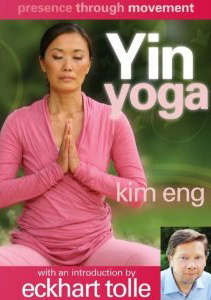
I am always on the look out for new Restorative, Yin and Deep Relaxation information. I recently purchased "Yin Yoga," a DVD by Kim Eng with an introduction by Eckhart Tolle.
The DVD features two practices plus a lecture/introduction with Eckhart Tolle. I came away from the introduction with the reminder to stay present in the practice, notice if you have discomfort or if your mind wanders. Bring the mind back to the present, time and time again. Do not run from discomfort; explore it.
Ms. Eng offers two practices: The Full Practice - Complete Yin Yoga (75 minutes) and the shorter Daily Practice (60 minutes) which is a copy of some of the poses from the full practice. Each practice is soothing and well presented. The style is voice-over set to Ms. Eng's practice in a beautiful garden. She did offer modifications and talked about using props but did not often show the props or use the props herself. I find in my classes that maybe one person per 15 does not need props - everyone else does. But I know that "no props" is more in the Yin style so I was not expecting to see any props or even talk about using props so I was pleasantly surprised.
There was no information pamphlet / table of contents in the DVD jacket which is a disappointment, but this seems to be the norm these days. However, this is definitely a DVD that I will watch / practice with again. I really enjoyed it. If you want more info, there are quite a few reviews on Amazon - some of which are very detailed and helpful.
The DVD features two practices plus a lecture/introduction with Eckhart Tolle. I came away from the introduction with the reminder to stay present in the practice, notice if you have discomfort or if your mind wanders. Bring the mind back to the present, time and time again. Do not run from discomfort; explore it.
Ms. Eng offers two practices: The Full Practice - Complete Yin Yoga (75 minutes) and the shorter Daily Practice (60 minutes) which is a copy of some of the poses from the full practice. Each practice is soothing and well presented. The style is voice-over set to Ms. Eng's practice in a beautiful garden. She did offer modifications and talked about using props but did not often show the props or use the props herself. I find in my classes that maybe one person per 15 does not need props - everyone else does. But I know that "no props" is more in the Yin style so I was not expecting to see any props or even talk about using props so I was pleasantly surprised.
There was no information pamphlet / table of contents in the DVD jacket which is a disappointment, but this seems to be the norm these days. However, this is definitely a DVD that I will watch / practice with again. I really enjoyed it. If you want more info, there are quite a few reviews on Amazon - some of which are very detailed and helpful.
Friday, September 2, 2011
Fall Reflection Retreat ~ Best Price Deal Extended
Return to Center Fall Reflection Retreat the weekend of September 30th
Think... camp... for adults.
This weekend retreat at beautiful Camp Amnicon, which is just 30 minutes from Duluth, will include many opportunities for group yoga daily, deep relaxation & meditation, lecture & conversation, hiking, sauna, rest, good food, & great community.
There will also be a guided Amnicon River Canoe trip, fall color hike, bonfires and opportunities for outdoor contemplation or worship. Makes an excellent gift for yourself or a loved one.
Led by Molly McManus & Sara Duke
Arrive: 6 pm Fri, Sept 30th
Depart: 4 pm Sun, Oct 2nd
Cost*: $225.00 or $202.50 if you register yourself online before the deadline. Use the promo code "10fall" when you check out online to receive an additional 10% off your enrollment.
$240.00 starting September 12th.
*Price includes Saturday and Sunday meals, daily yoga classes in postures and philosophy, guided canoe trip and the use of Camp Amnicon facilities.
Sign up online at Yoga North by clicking here or call the office at 218-722-YOGA.
Monday, August 22, 2011
A Practice of Noticing
Continuing on with our truth-seeking and self reflection....
I found an insightful article by Sally Kempton talking about how to delve into your own feelings and peel back the layers of emotions wrapping the heart. Here's the exercise she details:
If you want to read the entire article click here.
I found an insightful article by Sally Kempton talking about how to delve into your own feelings and peel back the layers of emotions wrapping the heart. Here's the exercise she details:
Start with Yourself. If you want to practice with intense energies, a good way to start is with your own feelings and moods, and to start small. Stephen Levine once wrote that working with heavy emotional issues can be like getting into the ring with a 500-pound wrestler—if you haven't trained for it, the wrestler will throw you in the first clench. One of the best ways to train for working with energy is to practice during private moments of meltdown.
One of my favorite times for this kind of practice is the onset of road rage. Like many otherwise reasonable people, I have an inner road warrior who emerges only when I'm alone behind the wheel. He's mouthy, cynical, easily offended—a cross between a New York City cabbie and one of those eccentric hit men from a Quentin Tarantino film. There's a lot of energy in this persona, however. So when I notice myself having snarly private dialogues with a driver who has cut me off at an exit, I try to use the occasion for exploring the energy inside my anger.
You can do this too, anytime. First, take a moment to remember one of your characteristic heavy emotions or the last time you were very angry, grief-stricken, or scared. When you've found the feeling you want to work with, here's what to do:
Acknowledge your feeling. Notice and identify the fact that your inner world has been rocked by an intense, primitive feeling. This is especially important when you've been ambushed by an emotion. It helps to say clearly to yourself, "I'm feeling angry," or, "I'm sad," or, "I'm upset." You don't have to analyze the feeling or even think about where it's coming from.
Pause. Stop yourself from acting on the feeling. To do this, focus on your breathing, following your breath as it moves in and out through your nostrils.
Get grounded. When we're experiencing strong emotions, we often lose touch with our physical body. To get grounded inside your body, bring your attention to the sensation of your feet on the ground; if you're sitting, feel the contact between your buttocks and the cushion or floor.
Bring your awareness into your heart. Once you're grounded, find your center in your heart—not your physical heart but your inner heart, the subtle energy space in the center of your body. If you touch your finger to the spot on your breastbone right between your nipples, you will probably find that there's a slight hollow there and even an achy feeling. Behind this little hollow lies your inner heart. Drop your attention into this center, using your breath as an anchor. Breathe in and out as if you were breathing in and out of your heart. Do this for a few minutes.
Explore the energy in the feeling. Once you have found your center like this, focus again on the feeling you are working with. Where is it in your body? How does it feel? This is not an analytical process; it is more of an exploration. You are giving yourself permission to fully feel and explore the inner sensations created by anger, sadness, injured pride, or fear. Feel whether the emotion is hard or prickly in your body. Notice if there's a color field around your mood. Someone told me that his depressed feelings actually feel grayish.
Let go of the story line. At this point, you'll notice that certain thoughts are attached to your particular emotion, thoughts that frequently begin "How could he?" or "I always..." Acknowledge these thoughts and then let them go, keeping your attention on the feeling rather than getting caught up in your personal story line.
Some people ask, "Suppose there is content in my feeling that needs to be dealt with psychologically or practically? Am I supposed to just let it go?" For the moment, yes. For this particular process, it's important to let go of believing the story that your thoughts and feelings are telling you. If you sense that something in these feelings or in the situation that provoked them needs specific action or attention, take note of it! You'll come back to it later on.
Hold the feeling inside your heart until it dissolves into awareness. Consciously bring the feeling-sense of your emotion into your heart. Hold the feeling inside the energy space in your heart. As you do, let your heart space expand, gently and slowly, until you have the sensation that there is real space around your feeling. Now notice what happens inside you, how the energy inside your anger or grief shifts. It might become sharper and more intense for a while, or it might begin to soften around the edges, to become less specific, less prickly or swampy.
It's important to realize that you aren't just trying to make yourself feel better. You are in a process of shifting your perspective about this feeling. Your intention is to explore its energy and to let that energy resolve itself back into its root, into the core energy of every feeling.
When we bring our heavy emotions into our heart space, it is as if we are bringing them into a place where they can be safely cradled. Psychologist Rudy Bauer has a great way of describing this. He says that holding our intense feelings in our consciousness is like holding hot coals in a basket. The basket contains the coals and allows heat to build up so that we can warm ourselves by their fire, but it also keeps the coals from burning us.
In this way, we can harness the energy inside our intense emotions and use it as a vehicle to move beyond our ordinary mind and toward the source, the Self, where we are powered and supported by something much larger than ourselves—something impersonal and yet loving, something that has no content and yet is full of wisdom. Abiding in this place, we understand what Rumi really meant when he said that fighting and peacefulness both take place within God. Whatever the quality of the times we live in, when we know how to enter the energy of intensity, we have discovered a doorway to the infinite.
Sally Kempton is the author of The Heart of Meditation. She also teaches Awakened Heart Meditation workshops. (For a schedule, visit www.sallykempton.com.)
If you want to read the entire article click here.
Labels:
Meditation,
Satya,
Svadhyaya
Monday, August 15, 2011
More Truth
I'm still contemplating the ramifications of truthfulness as I was discussing in the last post. What if we don't like what we see when we look inside ourselves? Or what if we are so scared to admit that we have value that we cannot look inside ourselves? What do we do then? Well, we keep trying. We use the Yamas & Niyamas to guide us and we practice non-harming (to self and others) and tapas (staying in the heat of the fire, i.e. staying with the discomfort and examining it). And we practice surrender - we go with life instead of fighting all the time.
Here's a little exercise. Ask yourself these questions:
1. What am I most afraid of?
2. If I could do anything at all, no restraints on time and money, what would it be?
3. What do I love most about myself?
Usually the 1st one is pretty hard to answer because most of us have to admit a fault here like, "I'm afraid everyone will see that I am a fraud. I don't really know what I am doing." The 2nd one can get pretty wild, "I'd travel the world, I'd quit my job, I'd learn another language," etc. Now the 3rd one, that's a doozy. How many of us can admit that we like anything about ourselves at all? Much less that we love something about ourselves.
Go ahead, jump in the fire and admit to yourself how many things about yourself are great. I'll start you off, "I love that I laugh a lot, I love that I'm learning to really see myself, I love that I am creative." Go on, keep on making your list.
ps - Here's an article from Yoga Journal to help you along a bit: Polishing the Mirror - the Practice of Self-Reflection.
Here's a little exercise. Ask yourself these questions:
1. What am I most afraid of?
2. If I could do anything at all, no restraints on time and money, what would it be?
3. What do I love most about myself?
Usually the 1st one is pretty hard to answer because most of us have to admit a fault here like, "I'm afraid everyone will see that I am a fraud. I don't really know what I am doing." The 2nd one can get pretty wild, "I'd travel the world, I'd quit my job, I'd learn another language," etc. Now the 3rd one, that's a doozy. How many of us can admit that we like anything about ourselves at all? Much less that we love something about ourselves.
Go ahead, jump in the fire and admit to yourself how many things about yourself are great. I'll start you off, "I love that I laugh a lot, I love that I'm learning to really see myself, I love that I am creative." Go on, keep on making your list.
ps - Here's an article from Yoga Journal to help you along a bit: Polishing the Mirror - the Practice of Self-Reflection.
Labels:
Ishvara Pranidhana,
Satya,
Tapas,
Yamas and Niyamas
Monday, August 8, 2011
Seeking the Truth in Yourself
![]() |
| Image from Wikipedia |
Mahatma Gandhi's non-violent resistance, satyagraha ("truth force"), influenced Mandela's approach to ruling in South Africa. This was portrayed wonderfully in the movie. Mandela's ability to see the truth in himself--his greatness, his flaws, his prejudice, his desire for revenge, his desire for peace--allowed him to rule from a place of equanimity. His ability to look beyond himself and ask, "What is the best course of action for all people of South Africa?" made him an incredible leader.
Since watching this movie I have been wondering what would happen if we could all be so fearless? What would happen if we could all look inside ourselves and see both the greatness and the smallness that makes us who we are? Could we recognize what hooks us if we could see ourselves with perfect truthfulness? Could we find love and forgiveness in our hearts for ourselves and others the way Mandela (and Gandhi) did?
Om Shanti, Shanti, Shanti. Peace, peace, peace.
Labels:
Reviews,
Satya,
Yamas and Niyamas
Subscribe to:
Posts (Atom)