Monday, August 22, 2011

A Practice of Noticing

Continuing on with our truth-seeking and self reflection....

I found an insightful article by Sally Kempton talking about how to delve into your own feelings and peel back the layers of emotions wrapping the heart. Here's the exercise she details:

Start with Yourself. If you want to practice with intense energies, a good way to start is with your own feelings and moods, and to start small. Stephen Levine once wrote that working with heavy emotional issues can be like getting into the ring with a 500-pound wrestler—if you haven't trained for it, the wrestler will throw you in the first clench. One of the best ways to train for working with energy is to practice during private moments of meltdown.

One of my favorite times for this kind of practice is the onset of road rage. Like many otherwise reasonable people, I have an inner road warrior who emerges only when I'm alone behind the wheel. He's mouthy, cynical, easily offended—a cross between a New York City cabbie and one of those eccentric hit men from a Quentin Tarantino film. There's a lot of energy in this persona, however. So when I notice myself having snarly private dialogues with a driver who has cut me off at an exit, I try to use the occasion for exploring the energy inside my anger.

You can do this too, anytime. First, take a moment to remember one of your characteristic heavy emotions or the last time you were very angry, grief-stricken, or scared. When you've found the feeling you want to work with, here's what to do:

Acknowledge your feeling. Notice and identify the fact that your inner world has been rocked by an intense, primitive feeling. This is especially important when you've been ambushed by an emotion. It helps to say clearly to yourself, "I'm feeling angry," or, "I'm sad," or, "I'm upset." You don't have to analyze the feeling or even think about where it's coming from.

Pause. Stop yourself from acting on the feeling. To do this, focus on your breathing, following your breath as it moves in and out through your nostrils.

Get grounded. When we're experiencing strong emotions, we often lose touch with our physical body. To get grounded inside your body, bring your attention to the sensation of your feet on the ground; if you're sitting, feel the contact between your buttocks and the cushion or floor.

Bring your awareness into your heart. Once you're grounded, find your center in your heart—not your physical heart but your inner heart, the subtle energy space in the center of your body. If you touch your finger to the spot on your breastbone right between your nipples, you will probably find that there's a slight hollow there and even an achy feeling. Behind this little hollow lies your inner heart. Drop your attention into this center, using your breath as an anchor. Breathe in and out as if you were breathing in and out of your heart. Do this for a few minutes.

Explore the energy in the feeling. Once you have found your center like this, focus again on the feeling you are working with. Where is it in your body? How does it feel? This is not an analytical process; it is more of an exploration. You are giving yourself permission to fully feel and explore the inner sensations created by anger, sadness, injured pride, or fear. Feel whether the emotion is hard or prickly in your body. Notice if there's a color field around your mood. Someone told me that his depressed feelings actually feel grayish.

Let go of the story line. At this point, you'll notice that certain thoughts are attached to your particular emotion, thoughts that frequently begin "How could he?" or "I always..." Acknowledge these thoughts and then let them go, keeping your attention on the feeling rather than getting caught up in your personal story line.

Some people ask, "Suppose there is content in my feeling that needs to be dealt with psychologically or practically? Am I supposed to just let it go?" For the moment, yes. For this particular process, it's important to let go of believing the story that your thoughts and feelings are telling you. If you sense that something in these feelings or in the situation that provoked them needs specific action or attention, take note of it! You'll come back to it later on.

Hold the feeling inside your heart until it dissolves into awareness. Consciously bring the feeling-sense of your emotion into your heart. Hold the feeling inside the energy space in your heart. As you do, let your heart space expand, gently and slowly, until you have the sensation that there is real space around your feeling. Now notice what happens inside you, how the energy inside your anger or grief shifts. It might become sharper and more intense for a while, or it might begin to soften around the edges, to become less specific, less prickly or swampy.

It's important to realize that you aren't just trying to make yourself feel better. You are in a process of shifting your perspective about this feeling. Your intention is to explore its energy and to let that energy resolve itself back into its root, into the core energy of every feeling.

When we bring our heavy emotions into our heart space, it is as if we are bringing them into a place where they can be safely cradled. Psychologist Rudy Bauer has a great way of describing this. He says that holding our intense feelings in our consciousness is like holding hot coals in a basket. The basket contains the coals and allows heat to build up so that we can warm ourselves by their fire, but it also keeps the coals from burning us.

In this way, we can harness the energy inside our intense emotions and use it as a vehicle to move beyond our ordinary mind and toward the source, the Self, where we are powered and supported by something much larger than ourselves—something impersonal and yet loving, something that has no content and yet is full of wisdom. Abiding in this place, we understand what Rumi really meant when he said that fighting and peacefulness both take place within God. Whatever the quality of the times we live in, when we know how to enter the energy of intensity, we have discovered a doorway to the infinite.

Sally Kempton is the author of The Heart of Meditation. She also teaches Awakened Heart Meditation workshops. (For a schedule, visit www.sallykempton.com.) 

If you want to read the entire article click here.

Monday, August 15, 2011

More Truth

I'm still contemplating the ramifications of truthfulness as I was discussing in the last post. What if we don't like what we see when we look inside ourselves? Or what if we are so scared to admit that we have value that we cannot look inside ourselves? What do we do then? Well, we keep trying. We use the Yamas & Niyamas to guide us and we practice non-harming (to self and others) and tapas (staying in the heat of the fire, i.e. staying with the discomfort and examining it). And we practice surrender - we go with life instead of fighting all the time.

Here's a little exercise. Ask yourself these questions:

1. What am I most afraid of?

2. If I could do anything at all, no restraints on time and money, what would it be?

3. What do I love most about myself?

Usually the 1st one is pretty hard to answer because most of us have to admit a fault here like, "I'm afraid everyone will see that I am a fraud. I don't really know what I am doing." The 2nd one can get pretty wild, "I'd travel the world, I'd quit my job, I'd learn another language," etc. Now the 3rd one, that's a doozy. How many of us can admit that we like anything about ourselves at all? Much less that we love something about ourselves.

Go ahead, jump in the fire and admit to yourself how many things about yourself are great. I'll start you off, "I love that I laugh a lot, I love that I'm learning to really see myself, I love that I am creative." Go on, keep on making your list.

ps - Here's an article from Yoga Journal to help you along a bit: Polishing the Mirror - the Practice of Self-Reflection.


Monday, August 8, 2011

Seeking the Truth in Yourself

Image from Wikipedia
I recently watched the movie Invictus, a portrayal of Nelson Mandela, acted by Morgan Freeman, set in the 1990's, the time period just after Mandela's release from 27 years of unjust incarceration. Mandela was elected  president by the first truly free election, the first multi-racial democracy, in 1994.

Mahatma Gandhi's non-violent resistance, satyagraha ("truth force"), influenced Mandela's approach to ruling in South Africa. This was portrayed wonderfully in the movie. Mandela's ability to see the truth in himself--his greatness, his flaws, his prejudice, his desire for revenge, his desire for peace--allowed him to rule from a place of equanimity. His ability to look beyond himself and ask, "What is the best course of action for all people of South Africa?" made him an incredible leader.

Since watching this movie I have been wondering what would happen if we could all be so fearless? What would happen if we could all look inside ourselves and see both the greatness and the smallness that makes us who we are? Could we recognize what hooks us if we could see ourselves with perfect truthfulness? Could we find love and forgiveness in our hearts for ourselves and others the way Mandela (and Gandhi) did?

Om Shanti, Shanti, Shanti. Peace, peace, peace.

Monday, August 1, 2011

Many forms of Meditation

Defining meditation is an elusive thing. I think it's hard to define because there are so many styles. There is not just one way to meditate. Frank Jude Boccio does a good job giving a brief explanation of a few types of meditation in his article Meditation for Everybody. I love how he explains meditation here:

A good deal of mystique has grown around meditation, yet it is one of the most natural of our human capacities. You've no doubt had moments in your life when you were not thinking or analyzing your experience, but simply "going with the flow." In these moments, there was no past or future, no separation between you and what was happening. That is the essence of meditation.

Contrary to a common misunderstanding, meditation is not a limiting or narrowing of our attention so much as it is a focusing on what is relevant. Our attention can be narrow, as in observing our breath, or broad, as in cooking a five-course dinner. When the mind is able to focus on what is relevant to what is happening now, we experience ourselves as being at one with what we perceive. This experience is deeply joyful, as we become freed from the illusion that we are separate from everything else in the universe. In fact, meditation isn't a withdrawal from life but a deeper, fuller presence in life.

Read his article in Yoga Journal to understand a bit more about a multitude of meditation styles.

Monday, July 25, 2011

Grounded in Gratitude

A few years ago I wrote an article called Finding Contentment about a gratitude practice I like to do. Today, I read an article by Frank Jude Boccio which talks about this and more. Here's a little excerpt:

On the surface, gratitude appears to arise from a sense that you're indebted to another person for taking care of you in some way, but looking deeper, you'll see that the feeling is actually a heightened awareness of your connection to everything else. Gratitude flows when you break out of the small, self-centered point of view—with its ferocious expectations and demands—and appreciate that through the labors and intentions and even the simple existence of an inconceivably large number of people, weather patterns, chemical reactions, and the like, you have been given the miracle of your life, with all the goodness in it today.

If this speaks to you and you want to read the rest of the article, visit Yoga Journal.

Monday, July 18, 2011

Yin Style Reclining Hero's Pose ~ Supta Virasana

Enjoy Yin Style Hero's Pose

Restorative style Virasana, as explored in the previous post, is a great place to start lengthening your quads. But at some point your body may be open enough to try Yin style Virasana, known as Saddle Pose. One of the beautiful things about Yin is that there is not a huge need for props like there is with Restorative. But still, there is some prep work involved.

Setting up for the pose:
For this version of Virasana, I like to start by laying on my back. Some folks are limber enough to sit on their shins with their bottoms on the floor and then lay themselves down backward but for most folks that is a bit much to start with.

Coming into the pose:
So, laying on your back, roll a bit to one side, bend your top leg's knee and pull that foot toward your bum. Try to roll back to the floor. This is Half Saddle or Half Reclining Hero's Pose.


As you linger here, you may find yourself wanting to pull your other leg in and open like so:


If these both seem crazy but you want a bit more stretch than the Restorative style Hero's Pose is giving you, then I recommend trying Supported Bridge Pose with a quad stretch:

This is nearly the same effect, as far as stretching the quads, but it gives you more space to tuck the foot towards the same side hip since the bum is off the floor. You can turn the foot under (toes point toward the same side shoulder) or you can draw the ankle toward you and keep the toes pointing away. Do one side at a time and try to maintain good alignment: shoulder, hip, knee in the same line. This video by Kira Ryder details the process.

While in the pose:
Keep breathing, keep observing the pose in your body, and allow the body to open at its own rate. Commit to the stillness but do allow yourself to adjust your body as you settle deeper in. Breath into any places where you habitually grip and try to soften. Stay as long as you are comfortable.

Coming out of the pose:
If you are in Supported Bridge Pose, lift your bottom, slide the block out from under you and come to rest on the floor. If you are already on the floor, roll to one side slightly and untuck one foot and then the other. If you were practicing 1/2 Hero's take the 2nd side. After the second side you can be done or you could try the full version of the pose. Take a few sacrum circles and then Little Bridge Pose to bring back stability.

This posture was super hard for me at first. I thought I had knee trouble but it turned out it was just tight quads. After a few months of practicing this posture regularly - starting with the Restorative style supported Hero's and eventually working to the Yin style Hero's - my knee discomfort has gone away.

Monday, July 11, 2011

Supported Reclining Hero's Pose ~ Supta Virasana

Enjoy Supported Reclining Hero's Pose

Hero's Pose can be a very tricky posture to come into for anyone with knee issues, tight quads or low back/SI joint problems. Luckily, with props, this posture can be made available to most people--comfortably--not just to "get through it."

Setting up for the pose:
Gather a number of different props: a few pillows/bolsters, a few blankets, and a couple of blocks. Test your ability to sit on your shins with your bum on the floor between your feet. If this does not happen for you in an upright, seated position, it is not going to happen in the reclining version either. You need support.

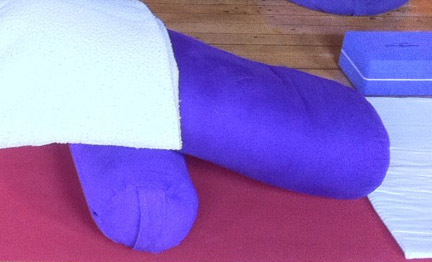
Set up a bolster or a thickly-rolled blanket behind you lengthwise. Place a block, bolster, or additional pillows under the end of the bolster where your head is going to lay to create a ramp set-up. Like so:

This bolster set-up is good for Reclining Hero's Pose or for Reclining Bound Angle.

Coming into the pose:
Sit in Dandasana (sit on your bum with legs straight) in front of your bolster ramp. Get very close to your props - let your back body touch the bolster. Bend one leg and tuck your foot by your outer hip. Carefully lower your body toward your bolster ramp, coming into Supported Reclining Half Hero's Pose.


If this feels ok and you want to go for full Supported Reclining Hero's Pose, come back to seated and tuck your other foot next to your other hip and repeat the careful laying down process.


If your knees are saying "NO WAY" then you need more propping. Give yourself something to sit on - like a folded blanket or a small bolster and make your bolster ramp higher. With these modifications, most folks should be able to do this pose. I've only ever had one student who absolutely could not do it.

While in the pose:
Keep breathing, keep observing the pose in your body, and allow the body to open at its own rate. Commit to the stillness but do allow yourself to adjust your props and your body as you settle deeper in. Notice if you are gripping the knees, quads, hips or back (or of course the usual places like the jaw, forehead or shoulders). Try to let these parts soften. Stay as long as you are comfortable.

Coming out of the pose:
To come up, support the torso with the hands on the floor, and either push yourself to a seated Hero's Pose or roll to one side slightly and untuck your feet, one at a time. If you were practicing 1/2 Hero's take the 2nd side. After the second side you can be done or you could try the full version of the pose.

This posture is great for creating length in the quads. There may be discomfort in the knees to start but by lengthening the quads this problem can go away - at least for me it did. However, if the knee discomfort is sharp, stabbing or causes you to hold your breath, I would recommend doing this pose only with supervision.

Happy Exploring!